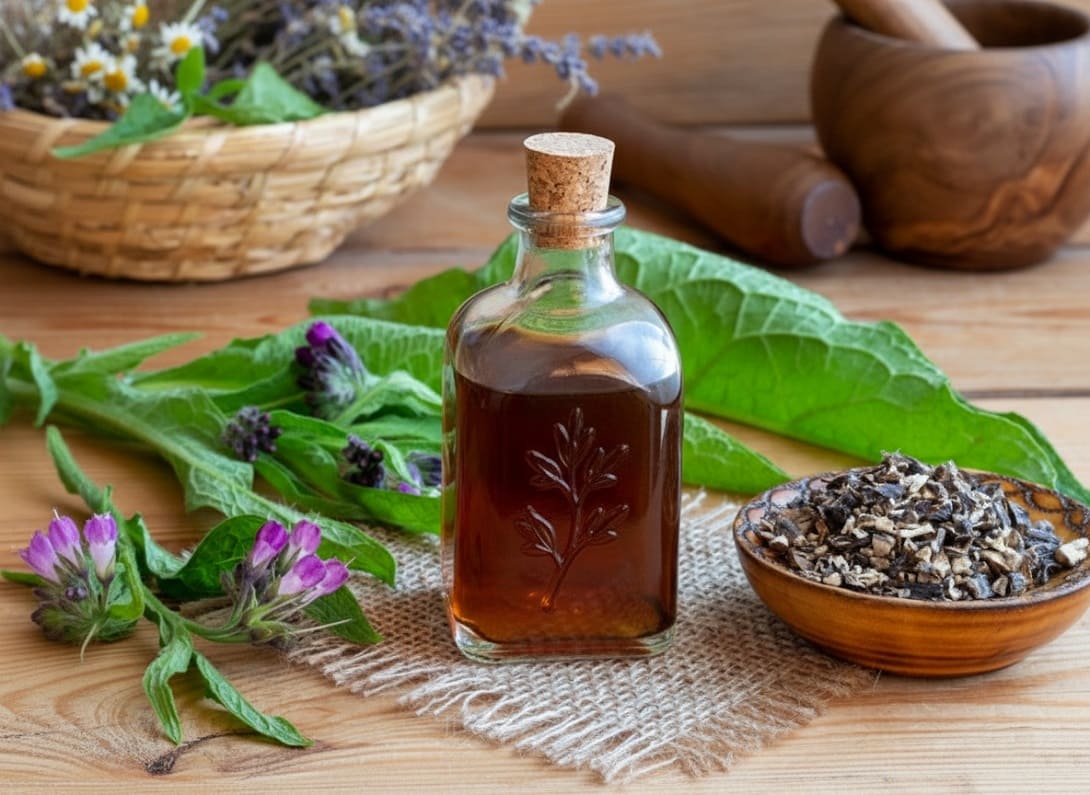
The first time I met comfrey oil, I was skeptical. My friend dabbed some golden-green liquid on her son’s scraped knee, and within minutes, his tears had stopped and the angry redness had calmed to a soft pink.
“It’s just mashed-up weeds and olive oil,” she said with a shrug. That was five years ago, and I haven’t bought commercial healing balms since.
In this guide, you’ll learn how to transform humble comfrey leaves into a concentrated healing oil—and whether you have six weeks or six hours, there’s a method that fits your timeline.
By the end, you’ll know exactly how to make, use, and store this time-tested remedy.
👉 Related post: How to Make Elderflower Cordial at Home (Traditional Recipe + Foraging Tips)
Why Comfrey Oil Works (And Why You Need to Be Careful)
Comfrey (Symphytum officinale) didn’t earn nicknames like “knitbone” and “boneset” by accident.
This perennial herb contains allantoin, a compound that stimulates cell proliferation—essentially helping your body create new skin cells faster.

Combined with rosmarinic acid, which reduces inflammation, comfrey becomes a powerful ally for external healing.
When you infuse comfrey into oil, you’re extracting these beneficial compounds into a form that’s easy to apply and penetrates the skin effectively.
The oil works for minor cuts and scrapes, bruises, muscle aches, joint discomfort, and dry or irritated skin.
But here’s the crucial part: Comfrey is so effective at healing surface tissue that it creates serious risks when used improperly.
Critical Safety Rules (Non-Negotiable)
Comfrey contains pyrrolizidine alkaloids (PAs) that damage the liver when consumed internally.
While only small amounts of PAs absorb through intact skin, you must follow these guidelines:
Never:
- Ingest comfrey in any form (tea, tincture, or oil)
- Apply to deep wounds, puncture wounds, or infected cuts (it will seal the surface before the inside heals, trapping infection)
- Use on broken or abraded skin
- Use during pregnancy or breastfeeding
- Apply to children under 3 without consulting a pediatrician
Always:
- Use only on shallow, clean wounds that have scabbed over, or on intact skin
- Do a patch test before widespread use (apply small amount to inner wrist, wait 24 hours)
- Limit continuous use to 4-6 weeks maximum, then take a break
- Discontinue immediately if any irritation occurs
With those boundaries clear, let’s dive into making this remarkable remedy.
Choosing Between Fresh and Dried Comfrey
Your first decision shapes everything else: will you use fresh or dried plant material?
Dried comfrey (recommended for beginners)

Dried comfrey is your best bet if you’re new to herbal preparations. It has dramatically lower moisture content, which means your oil won’t spoil or grow mold.
You can order high-quality dried comfrey leaf from Mountain Rose Herbs, Starwest Botanicals, or other reputable suppliers.
The dried leaves last for months stored in a cool, dark place, so you can make multiple batches.
👉 Here’s How to Dry Mint at Home (4 Easy Methods for Best Flavor)
Fresh comfrey (for experienced herbalists)

Fresh comfrey requires more attention but can yield a more potent oil.
If you’re harvesting from your garden, you must first reduce moisture content through wilting—otherwise that water will make your oil rancid or moldy within weeks.
- Here’s how to wilt fresh comfrey properly:
Harvest leaves on a dry afternoon, at least 36 hours after the last rain (wet leaves mean moldy oil).
Spread them in a single layer on clean screens or drying racks in a warm, well-ventilated area.
Let them sit until the edges become crispy and the leaves feel limp rather than juicy—typically 12 to 24 hours. They should still be green and pliable, not completely dried out.
One important distinction
Comfrey roots contain roughly ten times more PAs than leaves, making them riskier for topical use despite being more potent. I recommend sticking with leaves for your first batches.

If you do use roots, harvest them in fall after the first frost, scrub them thoroughly, slice them thin, and wilt them for 24 to 36 hours until the edges are crispy.
👉 Discover 9 Proven Dandelion Root Benefits: Nature’s Secret to Better Health
Selecting Your Carrier Oil
The carrier oil becomes the base of your remedy, so choose thoughtfully.
You want an oil that’s stable (resists going rancid), absorbs well into skin, and doesn’t have an overwhelming scent that masks the subtle earthiness of comfrey.
Olive oil remains the gold standard for comfrey infusions. Extra virgin olive oil resists oxidation beautifully, contains its own skin-nourishing properties, and won’t break the bank. It has a characteristic mild scent that most people find pleasant.
If you’re making salves to give as gifts or want a lighter feel, consider sweet almond oil—it absorbs quickly and has minimal scent, though it costs more and has a shorter shelf life.
Other options include coconut oil (which solidifies at room temperature and needs gentle warming), jojoba oil (technically a liquid wax, extremely stable but expensive), and grapeseed oil (lightweight but less stable).
For your first batch, olive oil offers the best balance of effectiveness, affordability, and forgiveness.
Whatever oil you choose, buy the freshest, highest-quality version you can afford. Check the expiration date—your finished comfrey oil will last only as long as your carrier oil would have.
Related posts:
- How to Use Horticultural Oil for Organic Pest Control: Timing, Rates & Safety Tips
- How to Use Neem Oil on Plants (Without Harming Your Garden)
The Cold Infusion Method: Time-Tested and Potent
This traditional approach requires patience but preserves comfrey’s delicate compounds most effectively. You’re essentially letting time do the work while you go about your life.
Gather your supplies
- Clean, completely dry glass jar (pint or quart size—mason jars work perfectly)
- Dried comfrey leaf
- Your chosen carrier oil
- Cheesecloth or fine mesh strainer
- Clean bowl for straining
- Storage jar or bottle (dark glass preferred)
- Label and pen

The process unfolds like this
1. Fill your jar about halfway to two-thirds full with dried comfrey leaves—don’t pack them tightly, as they need room to expand as they absorb oil.
2. Pour your carrier oil over the herbs until they’re completely submerged with about half an inch of oil showing above the plant material. This buffer is essential because the herbs will soak up oil over the first few days.
3. Take a chopstick, butter knife, or similar tool and gently stir through the jar, releasing air bubbles trapped between leaves. You’ll see them rise to the surface. Top off with more oil if needed to maintain that half-inch coverage.

4. Cap your jar tightly and give it a thorough label: “Comfrey oil – started [date]” at minimum.
Place the jar on a small plate or in a shallow bowl—herbal oils have a tendency to weep through lids, and you don’t want oil stains on your shelf.

5. Now comes the simplest but hardest part: waiting. Store your jar in a cool, dark cupboard and shake it gently every day or two.
Each shake redistributes the plant material and helps the oil extract more compounds. If you forget for a few days, don’t worry—the oil is forgiving.
6. Some herbalists prefer solar infusion, placing the jar in a brown paper bag on a sunny windowsill.
The gentle warmth speeds extraction slightly, though opinions vary on whether this affects potency. I’ve made excellent oils both ways.
7. After four to six weeks, you’re ready to strain. Line a fine-mesh strainer with several layers of cheesecloth and place it over a clean bowl.

Pour the oil through slowly—you’ll see it emerge a beautiful golden-green color, noticeably darker than when you started.
Gather up the edges of your cheesecloth and squeeze firmly, wringing out every last drop of precious oil.

8. Let the strained oil sit for 24 hours in the bowl. Sometimes a small amount of water or sediment settles to the bottom.
If this happens, carefully pour off just the clear oil into your storage container, leaving behind anything cloudy.
9. Transfer your finished oil to a clean, dark glass bottle or jar. Amber or cobalt blue glass protects the oil from light degradation, extending shelf life. Label clearly with contents and date.

Stored properly in a cool, dark place, your comfrey oil will maintain potency for up to one year, though it’s best used within six to nine months.
The Warm Infusion Method: When You Need It Faster
Sometimes you need comfrey oil next week, not next month.
The warm infusion method dramatically speeds extraction by gently heating the herbs and oil together—think of it as a slow, careful simmer that coaxes out the healing compounds in hours rather than weeks.
The key word here is gentle. Too much heat destroys the very compounds you’re trying to extract.
You want to maintain the mixture between 100°F and 120°F—warm enough to feel very warm to the touch but not hot enough to make you pull your hand away.
You’ll need
- Slow cooker or a pot for creating a double boiler
- Pint jar (leave uncovered during heating) or heat-safe bowl
- Dried comfrey and carrier oil (same proportions as cold method)
- Kitchen towel
- Thermometer (optional but helpful)
Here’s how it works
Combine your dried comfrey and oil in a pint jar or heat-safe bowl, filling it about two-thirds with herbs and topping with oil until everything is submerged.
Don’t cap the jar—you want moisture to evaporate rather than condensing back into your oil.
If using a slow cooker, fold a kitchen towel and place it in the bottom (this prevents the jar from rattling and possibly cracking).
Set your jar on the towel and add water to the slow cooker until it reaches about halfway up the jar.
Set to the lowest possible heat setting—ideally “warm” rather than “low” if your cooker has that option.
For stovetop infusion, create a makeshift double boiler by placing your jar or bowl in a pot with an inch or two of water. Keep the heat at the barest simmer.

Check periodically to ensure the water hasn’t evaporated (add more if needed) and the temperature stays in that gentle warmth range.
If you have a thermometer, aim for 110°F. Without one, the oil should feel pleasantly warm but not uncomfortable when you dip a finger in briefly.
Let this gentle heat work for anywhere from four to twelve hours. I usually run mine for eight to ten hours—long enough to extract the beneficial compounds without risking heat damage. Some herbalists go for a full 24 hours on the absolute lowest heat.
Once you’ve finished the heating period, let the mixture cool to room temperature, then strain using the same cheesecloth method described in the cold infusion section. Your oil is ready to use immediately.
Understanding What You’ve Made
Your finished comfrey oil should be a lovely golden-green color with a mild, slightly earthy, herbaceous scent.

If it smells musty, fermented, or like old salad dressing, something went wrong—usually too much moisture in the herbs. Discard it and start fresh.
Good comfrey oil has a pleasant, slightly thick consistency at room temperature. If using olive oil, it may turn cloudy and semi-solid in the refrigerator—this is normal. Simply let it come back to room temperature before use.
Putting Your Comfrey Oil to Work
The simplest use is direct application. For a sore muscle, bruise, or area of joint discomfort, warm a small amount between your palms and massage into the affected area.
A little goes a long way—start with a quarter-sized amount and add more if needed. Apply two to three times daily for best results.
For minor scrapes or shallow cuts that have scabbed over, gently dab the oil around the edges and on the scab itself.
Remember: only on wounds that have closed over and begun healing. The allantoin in comfrey is so effective at generating new skin cells that it can literally seal over a wound too quickly, trapping bacteria inside.
Comfrey oil works beautifully as a massage oil for areas prone to stiffness or chronic discomfort.
My mother swears by it for her arthritic fingers, warming the oil slightly and massaging it in each morning and evening.
Many women find it invaluable during pregnancy for belly massage to promote skin elasticity, and some midwives recommend perineal massage with comfrey oil in the weeks before birth.
You can also create a simple healing compress by soaking a clean cloth in warmed comfrey oil, wringing out the excess, and applying to the affected area for 15 to 20 minutes.
Transforming Oil Into Salve
While the oil works wonderfully on its own, sometimes you want something more portable and less messy.
Enter comfrey salve—your oil plus beeswax creates a firm, spreadable balm perfect for keeping in your bag, gym locker, or first aid kit.
You’ll need:
- 1 cup comfrey-infused oil
- 1 to 2 ounces beeswax (by weight)
- Small tins or jars for storing finished salve
- Optional: 10 to 15 drops essential oil (lavender or tea tree complement comfrey nicely)
The magic happens through a simple double-boiler process. Place a heat-safe bowl over a pot of gently simmering water.
Add your beeswax first, stirring occasionally as it melts. Once liquefied, pour in your comfrey oil and stir until completely combined.
Here’s where experience comes in: the ratio of beeswax to oil determines your final consistency.
For a spreadable salve that scoops easily from a tin, use about 1 ounce of beeswax per cup of oil. For a firmer lip-balm-style salve in tubes, increase to 1.5 or even 2 ounces of beeswax.
Test your consistency by spooning a small amount onto a cold plate and placing it in the freezer for two minutes.
Once set, check the firmness. Too soft? Remelt and add more beeswax. Too hard? Add more oil. This testing step saves you from having an entire batch that’s unusable.
If you’re adding essential oils for scent or additional therapeutic properties, wait until the mixture has cooled slightly—around 120°F if you have a thermometer, or when you can comfortably hold your hand against the side of the bowl.
Hot temperatures destroy the volatile compounds in essential oils.
Pour your finished salve into containers while still liquid. I prefer small two-ounce tins, which are perfect for gifts or keeping one at home and one in your bag.

Let them cool completely before putting on lids—usually two to three hours. As the salve cools, you’ll see it transform from liquid to a soft solid.
Properly made and stored, comfrey salve keeps for one to two years in a cool, dark place. If you notice any surface moisture, simply dab it away with a clean tissue—it’s harmless condensation.
When Things Don’t Go As Planned
- If your oil develops a musty smell during infusion:
This signals mold growth from excess moisture. Unfortunately, you need to discard it and start over.
Next time, make absolutely certain your herbs are thoroughly wilted or dried, and your jar is completely dry before you begin.
- If the herbs turn brown or black:
Dark discoloration can be normal if you used solar infusion or the warm method—it doesn’t necessarily mean something’s wrong.
However, if accompanied by a foul smell, discard it. The oil should smell pleasantly herbal.
- If oil appears to separate or has sediment at the bottom:
Perfectly normal. Let it settle for 24 hours after straining, then carefully pour off the clear oil from the top, leaving behind the sediment.
- If your salve is grainy instead of smooth:
This happens when beeswax cools too slowly or has been reheated multiple times. You can remelt it one more time and pour into containers, then place them in the refrigerator to cool quickly. This usually resolves the graininess.
- If herbs float to the top during infusion:
Top off with more oil daily for the first few days. As the dried herbs absorb oil, they’ll eventually sink. Just make sure they stay submerged to prevent mold.
Proper Storage: Making Your Medicine Last
Light, heat, and oxygen are the enemies of herbal oils. Store your comfrey oil in dark glass bottles if possible—amber, cobalt blue, or even clear glass wrapped in brown paper. Keep bottles in a cool, dark cupboard, not on a sunny windowsill or near the stove.
While many sources suggest refrigeration extends shelf life, I’ve found that high-quality olive oil-based preparations last perfectly well in a dark cupboard for six to nine months. Salves are even more stable, often lasting a year or longer.
How do you know when oil has gone bad? Trust your nose. Rancid oil smells like old crayons, rancid nuts, or stale vegetable oil—once you smell it, you’ll never forget it.
The color may also fade from golden-green to pale yellow. At that point, compost it and make a fresh batch.
A Brief Word on Growing Your Own
Once you fall in love with comfrey oil, you might want a constant supply at your doorstep. Comfrey is ridiculously easy to grow—in fact, the challenge is usually keeping it contained.
This hardy perennial tolerates most soil conditions, though it thrives in rich, moist earth with full sun to partial shade.
Plant it once, and you can harvest three to four times per season by cutting the leaves down to a few inches above ground. It regrows enthusiastically.
The catch? Comfrey spreads aggressively through its root system. Even a tiny piece of root left in the soil can sprout a whole new plant.
I learned this lesson when trying to relocate a patch—six months later, I had comfrey popping up in places I hadn’t planted it.
Choose your planting location carefully, ideally in a dedicated herb bed or contained area.
Final Thoughts: Simple Medicine, Profound Results
Making comfrey oil connects you to centuries of herbal wisdom while creating something genuinely useful.
There’s a quiet satisfaction in reaching for a remedy you made yourself—in knowing exactly what’s in it and feeling confident in its quality.
Start simple: one jar, dried comfrey from a reputable supplier, a bottle of good olive oil, and the cold infusion method.
Mark your calendar six weeks out. While you wait, gather a few small tins and consider who might appreciate a jar of handmade healing salve for the holidays.
The process teaches patience in our instant-gratification world. Each time you shake that jar over the next six weeks, you’re participating in an ancient practice of extracting healing from plants.
When you finally strain your golden-green oil, you’ll understand why herbalists have treasured this humble plant for thousands of years.
Have you made comfrey oil or used it for healing? I’d love to hear about your experiences in the comments below.
Disclaimer: This information is for educational purposes only and is not intended as medical advice.
Comfrey contains compounds that can be toxic when used improperly. Always consult your healthcare provider before using herbal remedies, especially if you have medical conditions, are pregnant or nursing, or are taking medications.
The author and publisher are not responsible for any adverse reactions or consequences resulting from the use of any suggestions or information in this article.

