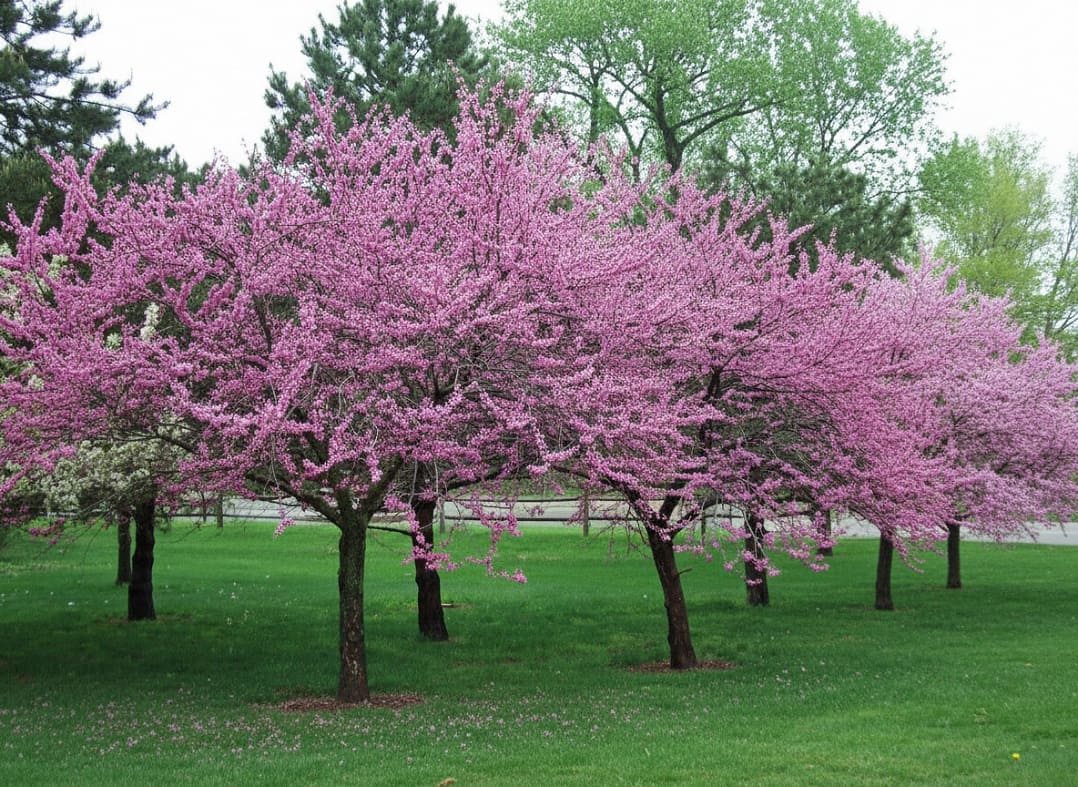
Picture this: You’re sipping your morning coffee, gazing out the window, when your neighbor’s yard erupts in a cloud of pink cherry blossoms. Meanwhile, your yard looks… well, let’s just say it could use some pizzazz.
Flowering trees transform ordinary landscapes into something extraordinary. They deliver spectacular seasonal displays, attract wildlife, provide shade, and many offer year-round interest beyond just their blooms.
Whether you’re working with a compact urban lot or sprawling suburban acreage, there’s a flowering tree that fits.
This guide will help you select the ideal flowering tree for your specific conditions, avoid expensive mistakes, and ensure your tree thrives for decades.
By the end, you’ll know exactly which tree deserves that prime spot in your landscape.
Why Flowering Trees Are Smart Landscape Investments
Beyond their obvious beauty, flowering trees deliver surprising value:
- They’re ecosystem builders
Early bloomers like serviceberry provide critical nectar for pollinators emerging from winter, while late-season fruits feed migrating birds. One tree creates an entire habitat hub.
- Property value climbs
Mature, well-placed trees increase property values by 7-15%, and flowering varieties add irresistible curb appeal.
- Low-maintenance once established
Unlike lawns or flower beds demanding weekly attention, most flowering trees need only annual pruning and occasional watering after their first season.
- Multi-season performers
The best selections offer spring blooms, summer shade, fall color, winter bark interest, and wildlife value—five benefits from one plant.
Related posts:
- The 60+ Best Fragrant Plants & Flowers for Scented Gardens Every Season
- 40 Stunning Winter Flowers That Bloom in Snow & Transform Your Cold Garden
- 36 Common Flowering Weeds: Complete Identification Guide
Choosing Your Perfect Tree: The Critical Decisions
Hardiness Zone: Your Non-Negotiable Starting Point
A magnolia that thrives in Georgia will struggle—or die—in Minnesota. Find your USDA Hardiness Zone (30-second online search) and stick within it. Pushing boundaries usually means replacing dead trees.
But zones tell only part of the story. Two zone 7 gardens—one in humid Virginia, one in dry New Mexico—need different trees.
Consider your local rainfall patterns, summer heat intensity, and humidity levels. A tree native to your region faces fewer challenges than exotic imports.
Size Matters More Than You Think
That adorable 5-foot nursery sapling might tower 50 feet in 20 years. Before choosing any tree:
- Measure your space.
You need both height and width clearances. Power lines overhead? Patio underneath? Neighboring property 10 feet away? Map it out.
- Calculate proper placement.
Plant trees 15-20 feet from foundations to protect both roots and structures. Driveways and walkways need similar buffers—mature canopies and root systems can heave pavement.
- Consider the view.
Will this tree eventually block a window you love? Shade your vegetable garden? Create a privacy screen—or destroy one?
Here’s a sizing reality check:
A 30-foot-wide mature canopy means the trunk should be planted 15 feet from anything you don’t want shaded or damaged. Small yard? Choose small trees.
Matching Trees to Your Site Conditions
Fighting your site conditions is exhausting and expensive. Work with what you have:
- Sun exposure dictates bloom quality
Most flowering trees need 6+ hours of daily sun for maximum flower production.
However, dogwoods and redbuds actually appreciate afternoon shade in hot climates—their blooms last longer and foliage doesn’t scorch.
- Soil pH and drainage are deal-breakers.
Test your soil before shopping. Most flowering trees prefer slightly acidic (pH 6.0-6.5), well-draining soil.
But if you have alkaline clay, don’t fight it—choose hawthorns or crabapples that tolerate it.
- When should you amend soil?
Only when it’s truly terrible—heavily compacted clay, pure sand with no organic matter, or pH extremes above 8.0 or below 5.0.
Otherwise, let trees adapt to native conditions. A cushy amended planting hole just delays inevitable adjustment and can create drainage problems.
- Water availability shapes success
Be honest:
Will you water weekly? Choose drought-tolerant crape myrtles or smoke trees.
Prefer low-maintenance? Eastern redbuds and serviceberries handle variable moisture once established.
Understanding Root Systems (The Hidden Deal-Breaker)
Most tree descriptions skip this critical information, but root behavior determines where you can safely plant:
- Shallow, aggressive roots (willows, some cherries, poplars) heave sidewalks, clog drains, and compete with nearby plants. Keep these 20+ feet from hardscapes and foundations.
- Deep taproots (redbuds, magnolias) dive straight down with less lateral spread—better near patios and walkways.
- Non-invasive fibrous roots (dogwoods, crabapples, serviceberries) spread moderately without causing problems—your safest bet near structures.
Ask nursery staff about root characteristics before buying. This single question prevents thousands in future repair bills.
The Best Flowering Trees by Bloom Season
Strategic selection creates months of continuous color. Here are top performers organized by bloom period, with specific timing you can plan around:
Early Spring Explosions (March-April)
These brave bloomers flower before or as leaves emerge, creating dramatic displays against bare branches.
Eastern Redbud (Cercis canadensis)
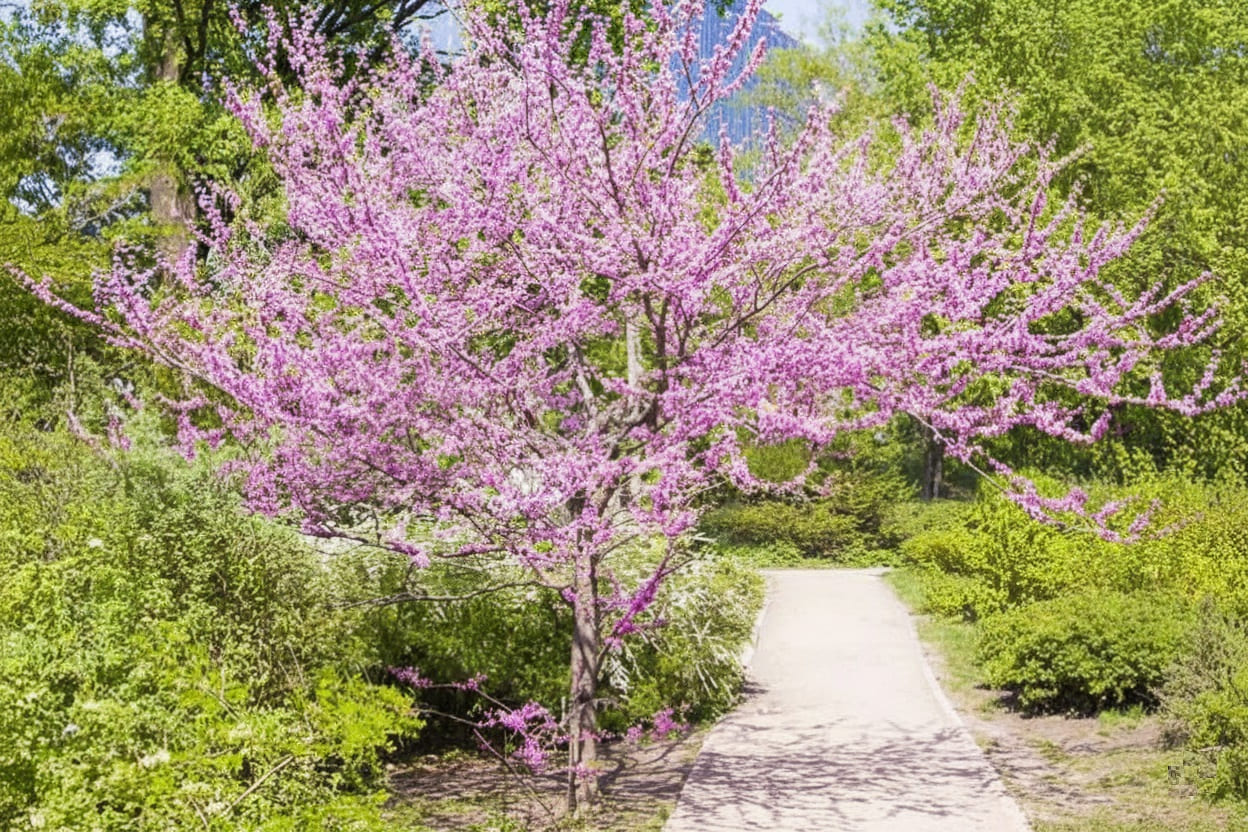
In late March through April, rosy-pink blooms appear directly on branches—even the trunk erupts in flowers.
This 20-30 foot native adapts to most soils and handles sun or partial shade across zones 4-9. Heart-shaped leaves follow the flowers and turn butter-yellow by October.
The redbud’s trick? It blooms within 3-4 years of planting, unlike many trees that make you wait a decade. Bonus: Fibrous roots won’t threaten your foundation.
Yoshino Cherry (Prunus x yedoensis)
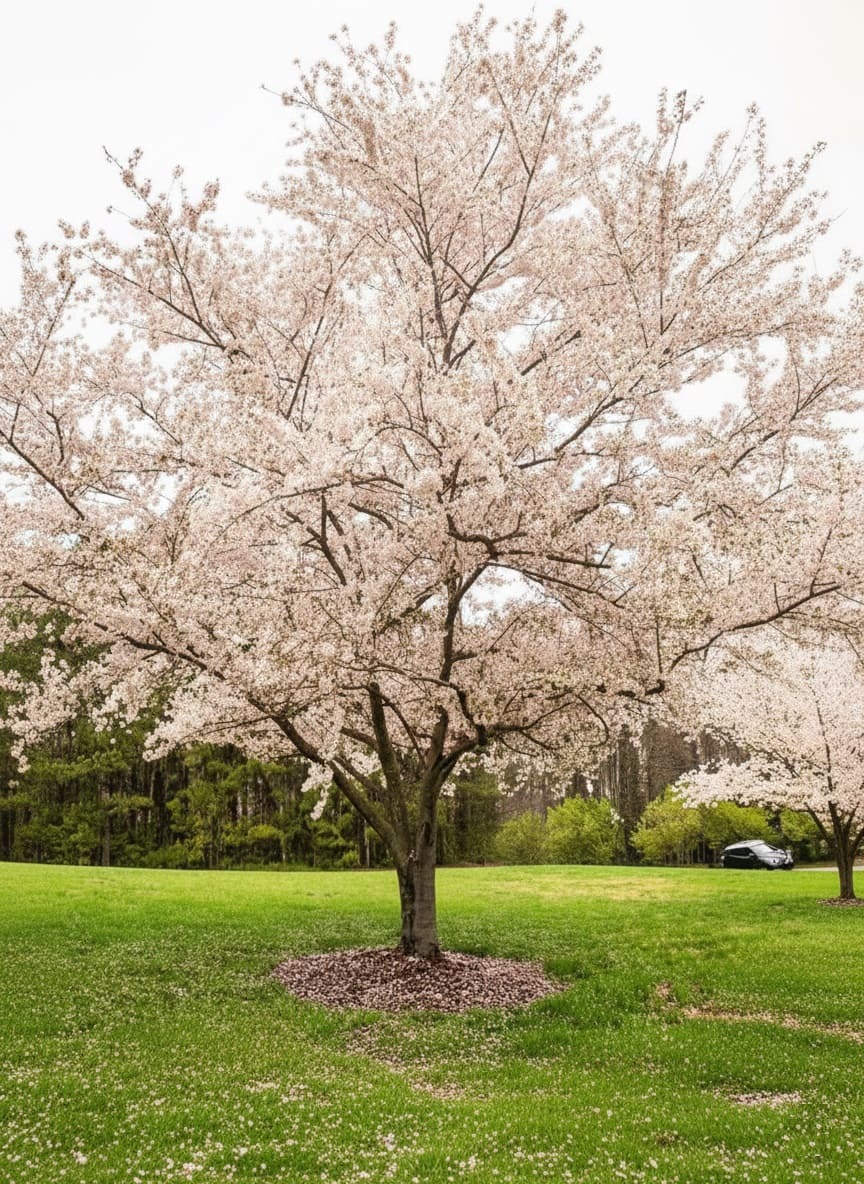
From late March to mid-April, clouds of pale pink blossoms with subtle almond fragrance blanket this 40-50 foot tree.
It’s the species that made Washington D.C. famous each spring, growing fast and creating dramatic impact.
- The reality check:
Bloom period lasts only 10-14 days. Fall color is minimal. And shallow roots can lift pavement if planted too close.
Reserve this showstopper for larger properties where you have placement flexibility (zones 5-8).
Star Magnolia (Magnolia stellata)
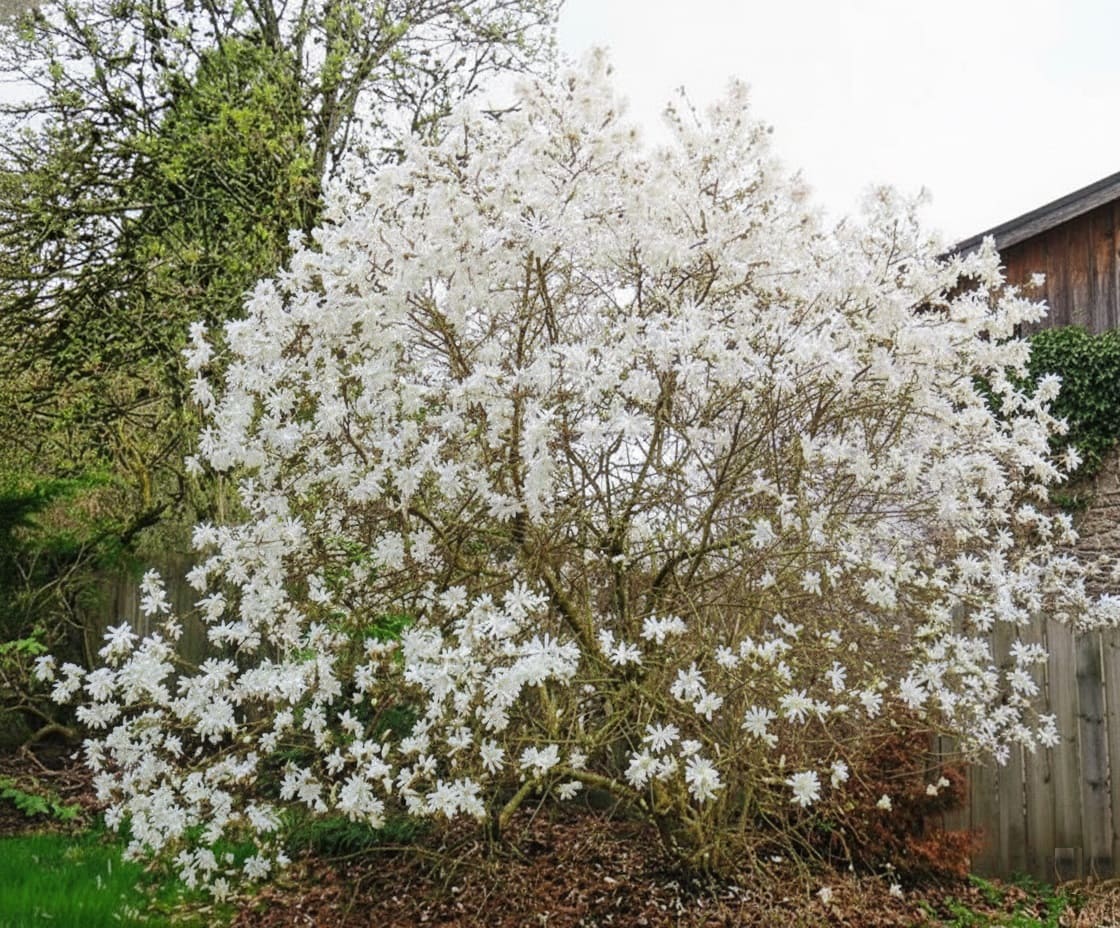
Before most trees wake up, hundreds of fragrant white star-shaped flowers transform this compact 15-20 foot magnolia in early to mid-April.
Perfect for smaller yards or near entryways where you’ll appreciate the fragrance (zones 4-9).
- Placement tip:
Avoid south-facing walls. They encourage early blooming that late frosts can destroy. Northern or eastern exposures protect developing buds.
Flowering Plum (Prunus cerasifera)
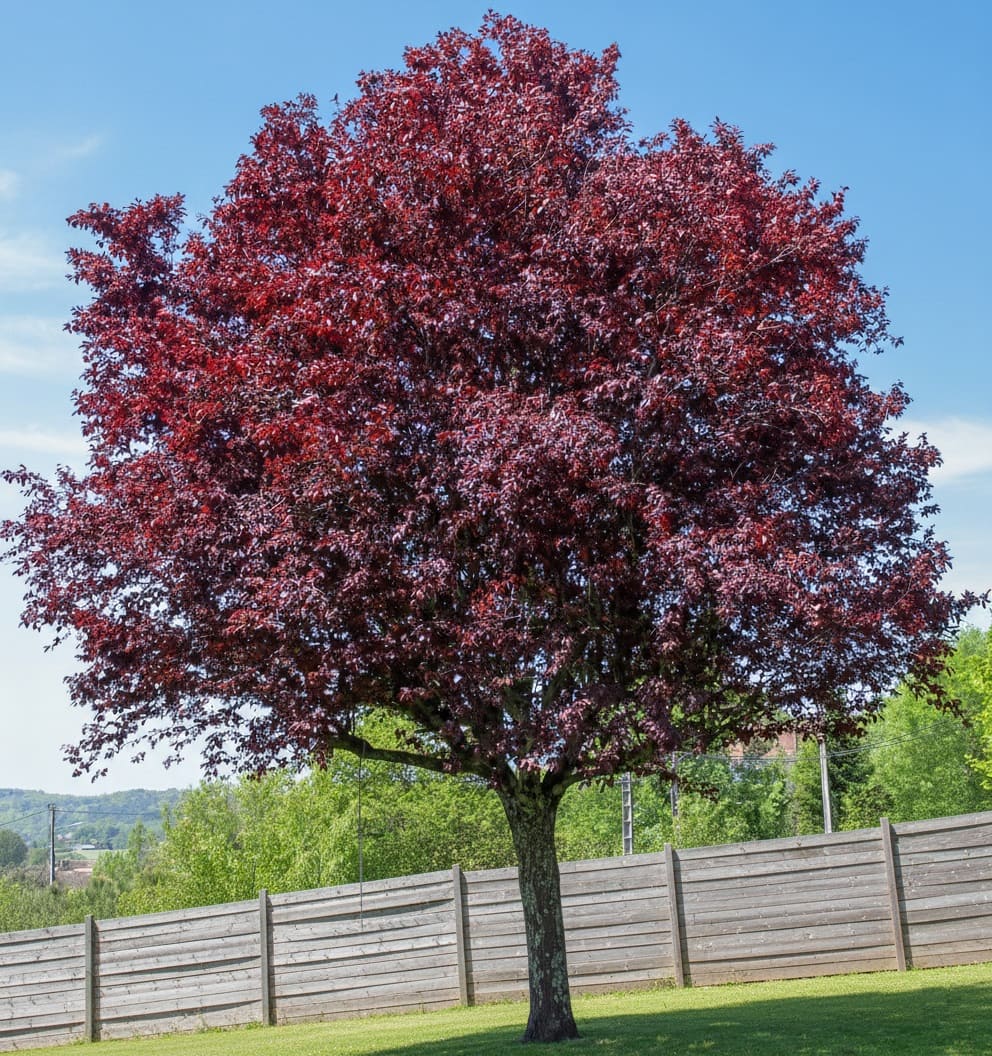
If you want color before anything else blooms, flowering plum delivers in late March with clouds of pale pink to white flowers on bare branches.
The purple-leaved varieties like ‘Newport’ and ‘Thundercloud’ add drama all season with deep burgundy foliage that contrasts beautifully with the pink blooms. These fast-growing trees reach 15-25 feet (zones 4-9).
- The trade-off:
Relatively short-lived (15-20 years) and can be messy with fallen fruits. But for early color and unique foliage, few trees compete.
Cornelian Cherry (Cornus mas)
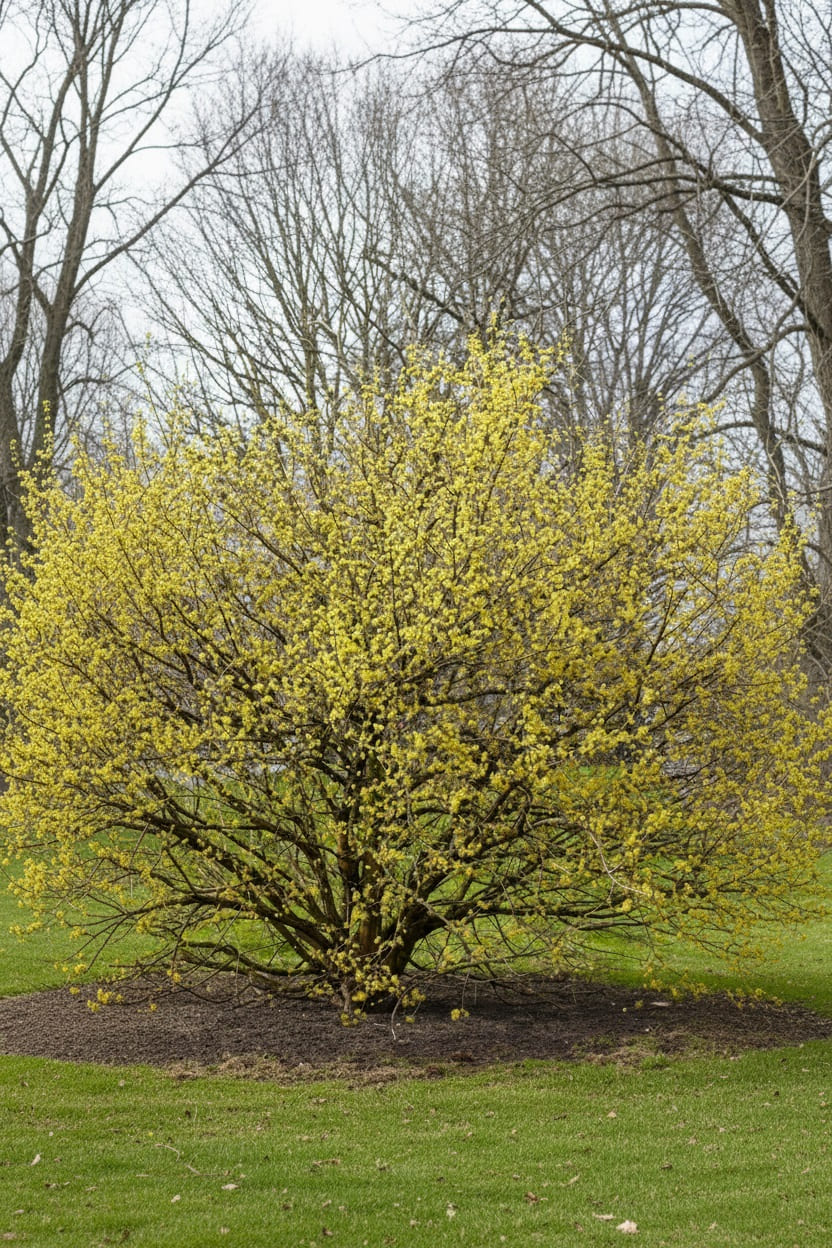
Not a true cherry but a dogwood, this overlooked gem explodes with bright yellow clusters in late February through March—often the first tree to bloom. The small flowers pack branches densely, creating a golden haze.
By August, edible red fruits appear that make excellent jams. Fall brings purple-red foliage on this 20-25 foot tree (zones 4-8).
Cornelian cherry handles urban pollution and drought once established, making it ideal for tough city sites where other trees struggle.
Late Spring Bloomers (Late April-May)
As temperatures warm and foliage fills in, these trees add another wave of color:
Flowering Dogwood (Cornus florida)
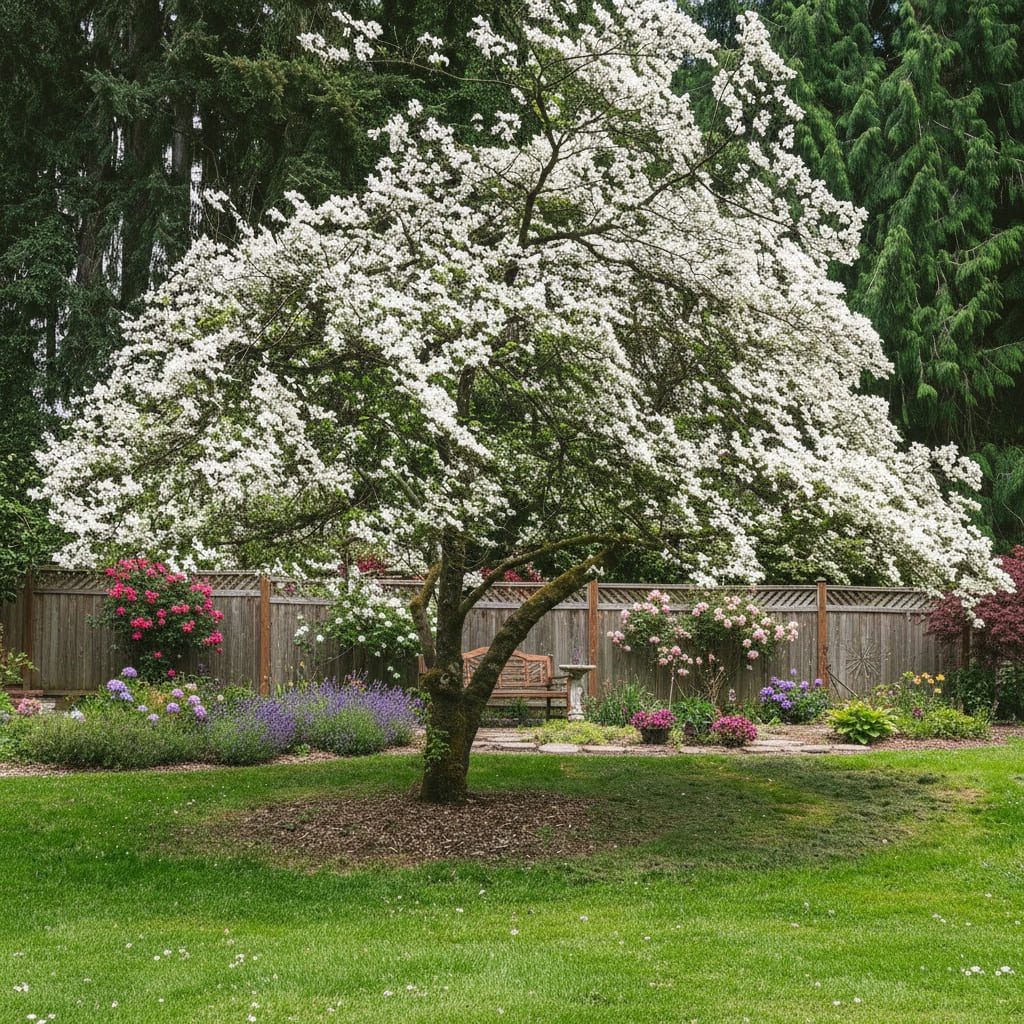
In late April through May, large white or pink bracts (modified leaves surrounding tiny true flowers) create a layered canopy effect.
This native reaches 15-30 feet with distinctive horizontal branching that looks sculptural even in winter.
- The complete package:
Spring flowers, red berries that birds devour by July, burgundy fall foliage, and interesting bark.
Newer cultivars like ‘Appalachian Spring’ resist the anthracnose disease that plagued older varieties (zones 5-9).
- Dogwoods need attention to placement:
They’re understory trees in nature, so afternoon shade in hot climates prevents leaf scorch and extends bloom time.
Saucer Magnolia (Magnolia x soulangeana)
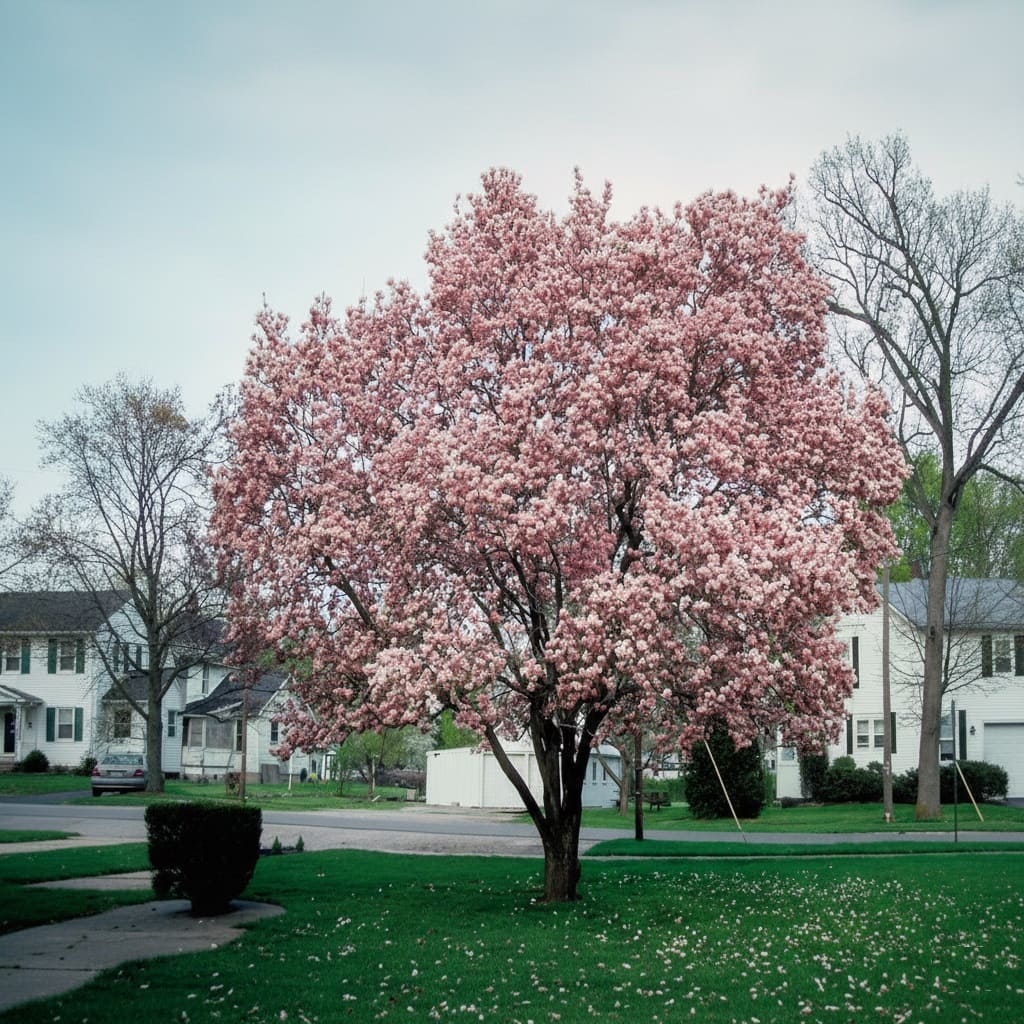
Six-inch cup-shaped flowers in shades from white to deep purple-pink appear in late April before leaves emerge.
This 20-30 foot magnolia works beautifully in smaller yards, though the early blooming can be frost-vulnerable in colder zones.
Plant this away from frost pockets (low-lying areas where cold air settles) and southern exposures that promote too-early flowering. Zones 4-9.
Serviceberry (Amelanchier spp.)
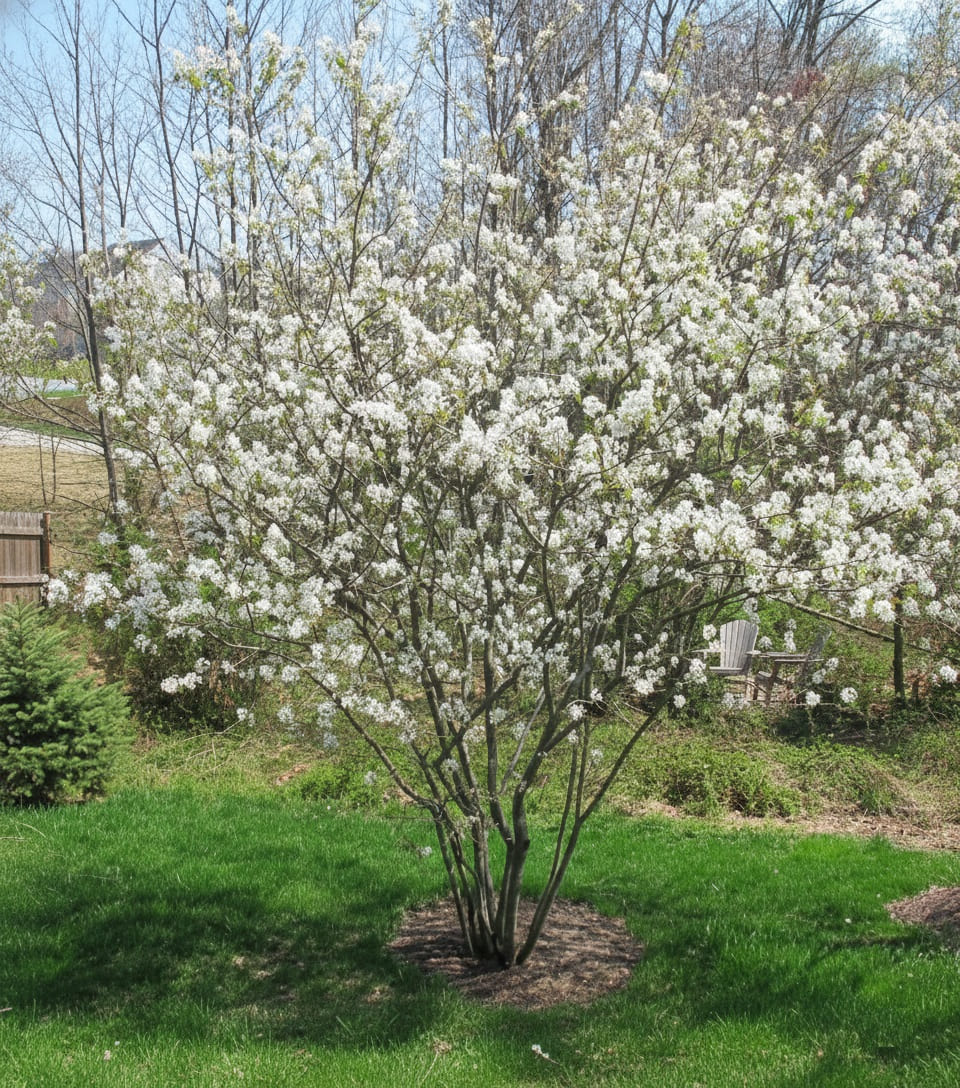
Delicate white flower clusters in late April kick off this native’s year-long show.
By June, edible purple-black berries appear—if birds don’t devour them first. Fall delivers brilliant orange-red foliage on this 15-25 foot multi-stemmed tree.
Serviceberry’s superpower? Extreme adaptability. It handles wet or dry soil, sun or partial shade, and survives to zone 4 while thriving in zone 9.
Plus, those fibrous roots won’t crack your driveway (zones 4-9).
Golden Chain Tree (Laburnum x watereri)
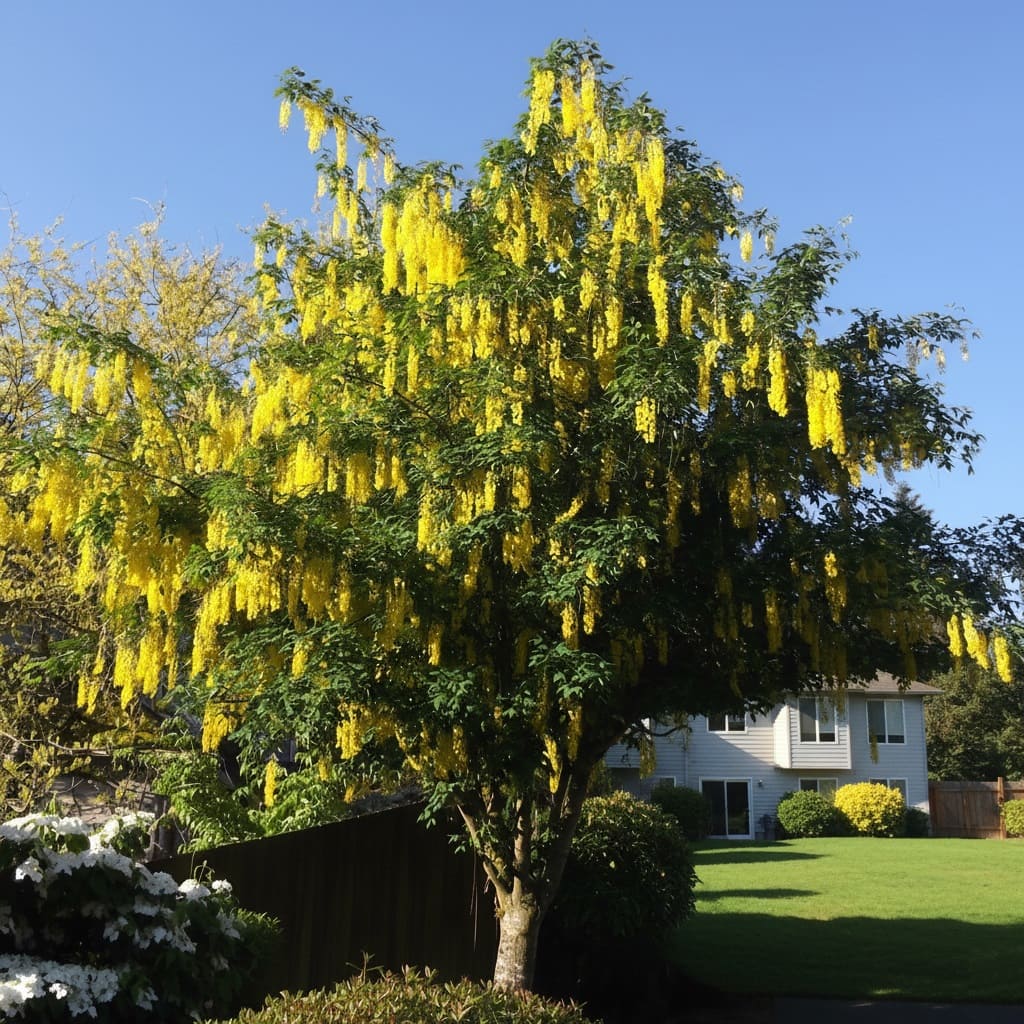
In May, this stunning tree drapes itself with foot-long clusters of golden-yellow flowers that hang like wisteria.
The display is breathtaking but brief—about two weeks. This 15-25 foot tree works well as a specimen or trained over arbors (zones 5-7).
- Critical warning:
All parts are highly toxic, especially the seed pods. Not suitable for yards with young children or pets.
Also relatively short-lived (20-30 years) and prefers cool summers—struggles in hot, humid climates.
Flowering Crabapple (Malus cultivars)

May brings an explosion of white, pink, or red flowers—often so profuse they completely hide the foliage.
Modern disease-resistant varieties like ‘Prairifire,’ ‘Royal Raindrops,’ and ‘Spring Snow’ offer incredible flower displays followed by small colorful fruits that persist into winter, feeding birds when food is scarce.
Size varies from 8 to 30 feet depending on cultivar (zones 4-8).
Choose varieties with persistent fruits (stay on tree) versus early-drop types to minimize lawn mess. The smaller the fruit, the less cleanup required.
Black Locust (Robinia pseudoacacia)
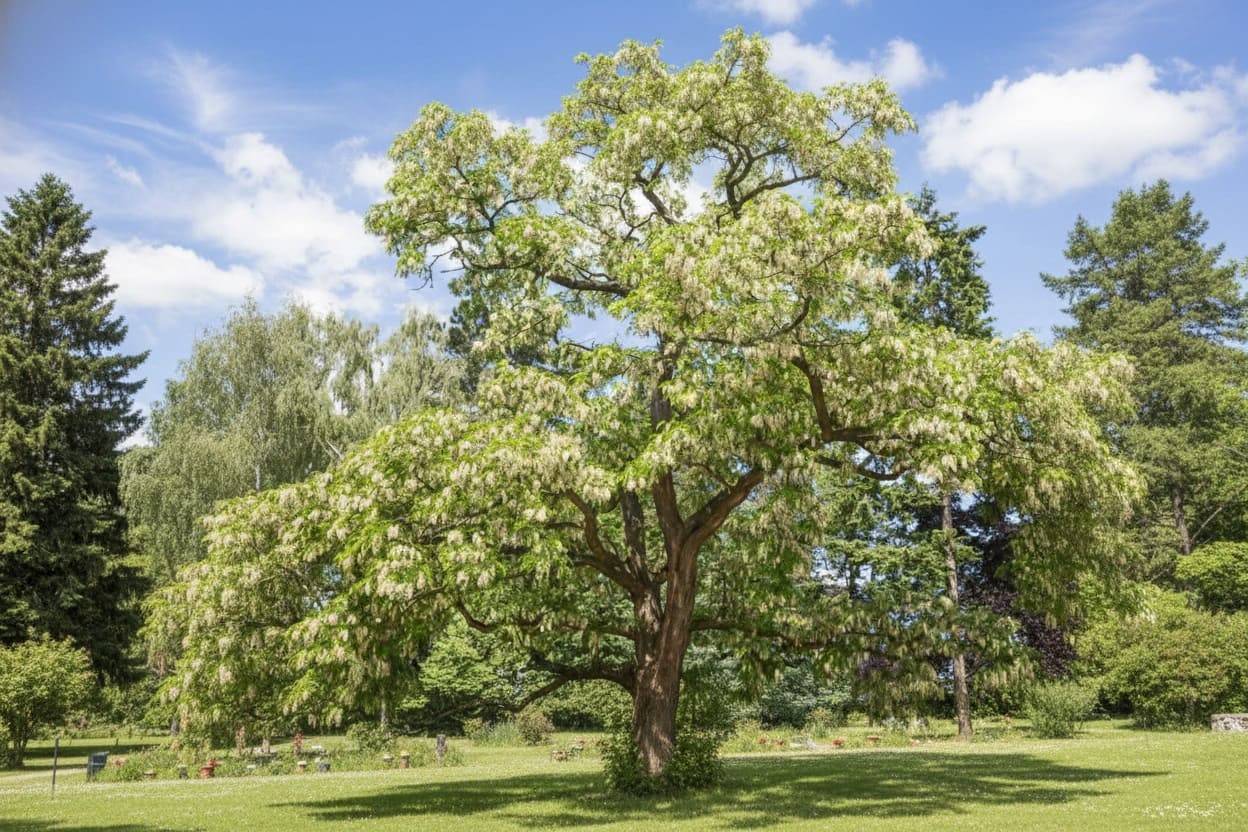
Fragrant white flower clusters appear in late May, filling the air with a sweet pea-like scent that attracts bees from blocks away.
This fast-growing native reaches 40-50 feet with an open, airy canopy that casts filtered shade—perfect for underplanting (zones 3-8).
- The drawbacks:
Thorny branches, suckering habit (sends up shoots from roots), and brittle wood prone to storm damage.
Best used in naturalized areas or where its aggressive nature won’t cause problems. The cultivar ‘Purple Robe’ offers deep pink flowers with less suckering.
Hawthorn (Crataegus spp.)
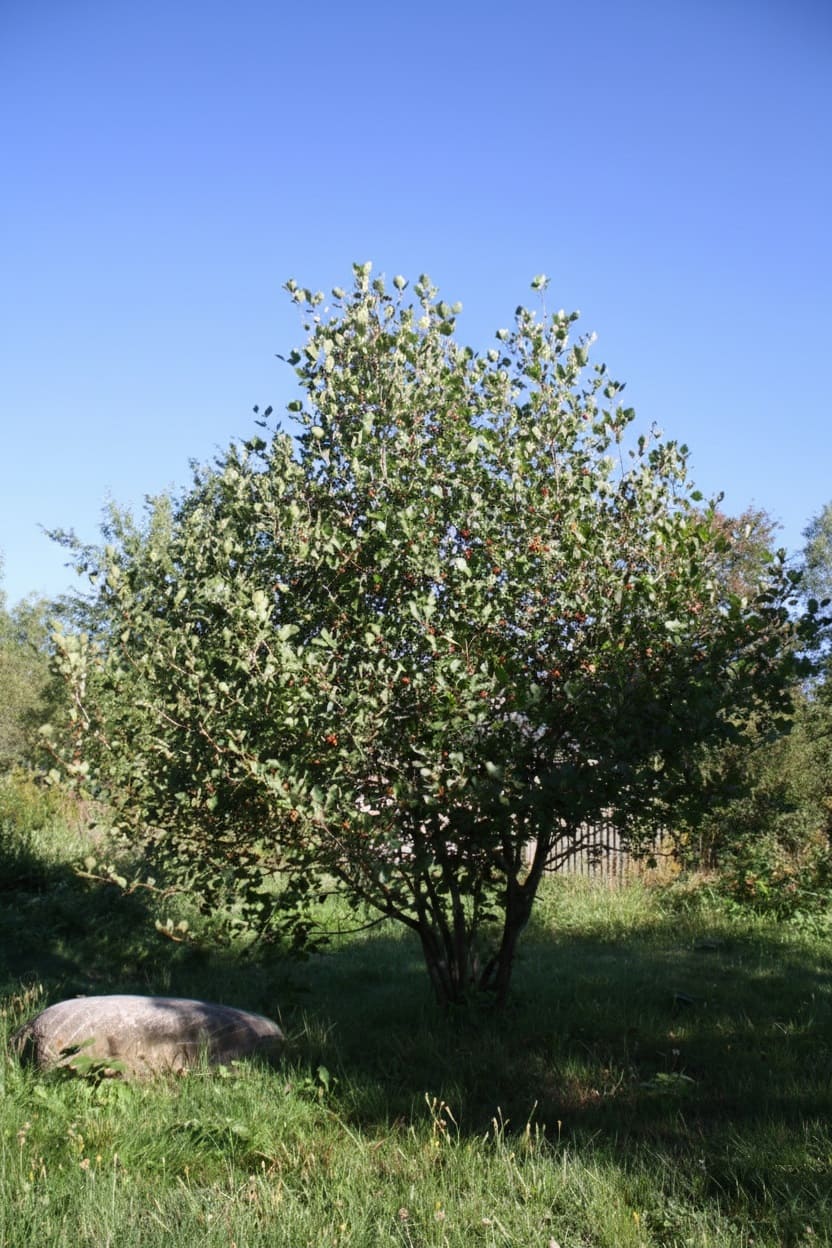
Clusters of white, pink, or red flowers in May lead to persistent red berries and orange-red fall color.
The dense, thorny branching (on most species) deters intruders while providing excellent bird nesting habitat. Most grow 15-30 feet.
Washington hawthorn (C. phaenopyrum) offers the best fruit display and handles urban conditions beautifully (zones 4-8).
Summer Bloomers (June-September)
Most flowering trees finish by June, making these summer performers especially valuable:
Crape Myrtle (Lagerstroemia indica)

From June through September—sometimes October in warm zones—clusters of crepe-paper-textured flowers in white, pink, red, or purple cover this tree.
Size varies wildly from 3-foot dwarfs to 30-foot standards, so choose carefully.
The complete summer package includes that extended bloom period, gorgeous exfoliating bark revealing cinnamon and gray tones, and brilliant fall color in orange and red.
Once established, crape myrtles handle drought and heat that would wilt other trees.
- Pruning note:
Crape myrtles bloom on new growth, so prune in late winter before spring growth begins.
Skip the terrible “crape murder” topping you see everywhere—it weakens trees and ruins their natural form (zones 7-10, some varieties to zone 6).
👉 Learn How to Prune Roses: A Simple Guide for Stunning Results
Chaste Tree (Vitex agnus-castus)
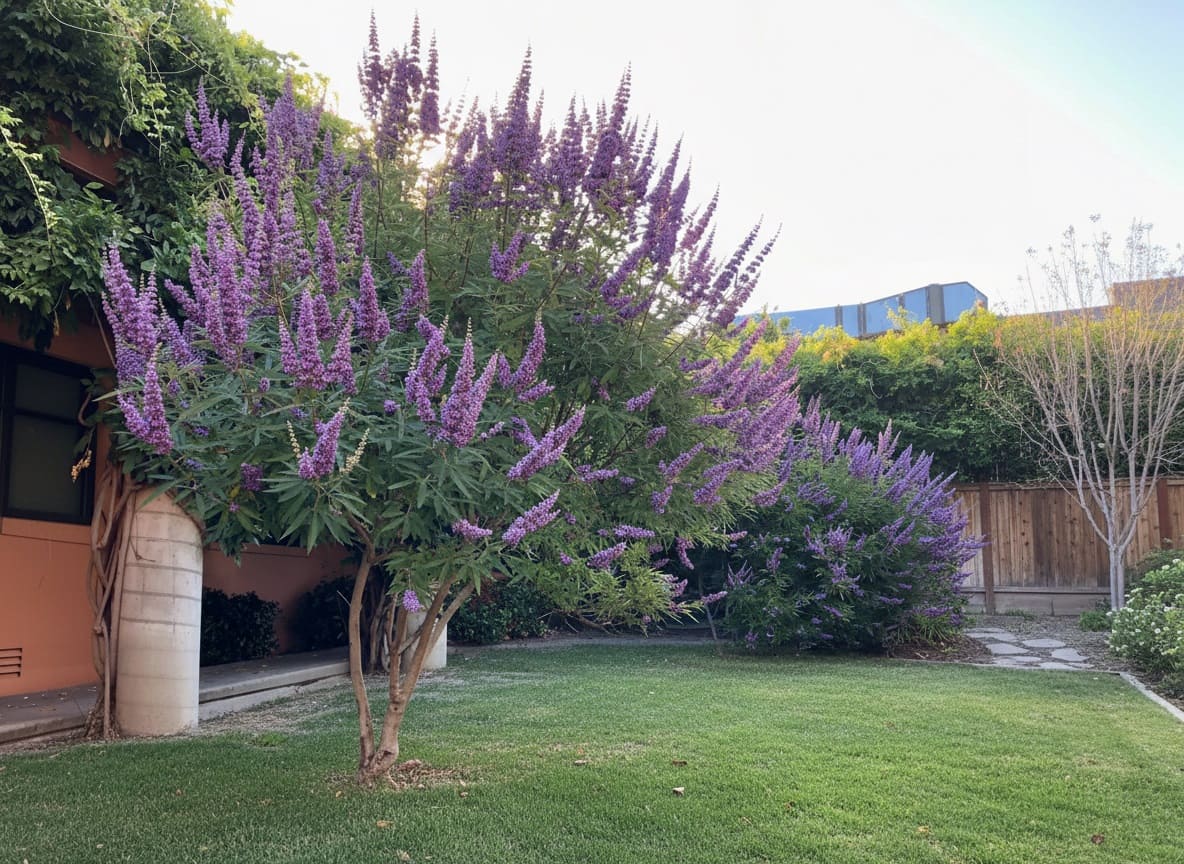
Fragrant lavender-blue flower spikes appear continuously from June through September on this 10-15 foot tree (or large shrub—it depends on pruning). Butterflies and bees mob the blooms.
In zones 5-6, chaste tree often dies back to the ground in winter but re-emerges vigorously in spring, blooming the same year on new growth.
In warmer zones (7-9), it develops into a small tree with interesting multi-stemmed structure.
Southern Magnolia (Magnolia grandiflora)
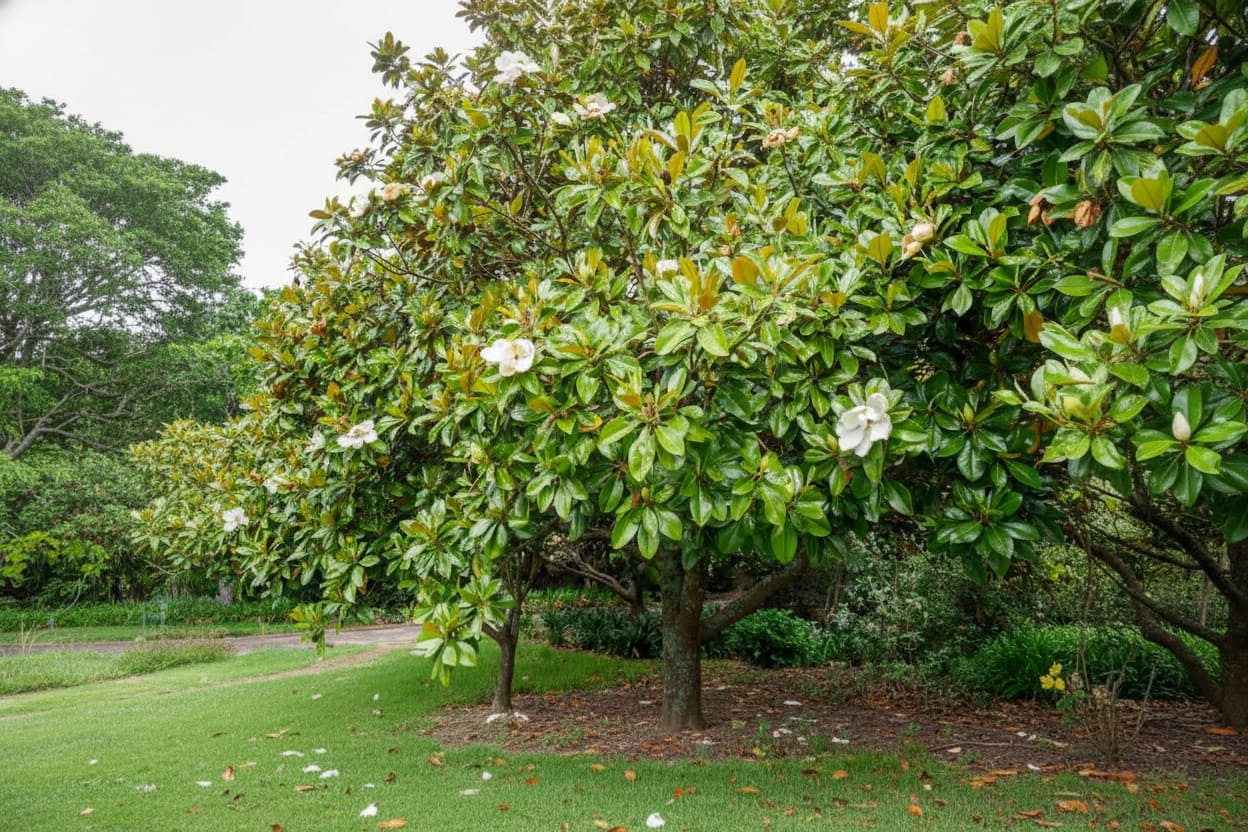
Massive 8-12 inch creamy white flowers with intoxicating lemon-vanilla fragrance appear from May through August against glossy evergreen leaves.
This is a large tree—60-80 feet—demanding substantial space.
The evergreen foliage provides year-round structure, but dropped leaves, flower petals, and cone-like fruits create ongoing cleanup. Plant away from lawns where you want pristine grass.
Compact cultivars like ‘Little Gem’ (20-25 feet) deliver the same features in smaller packages (zones 7-10).
Japanese Tree Lilac (Syringa reticulata)
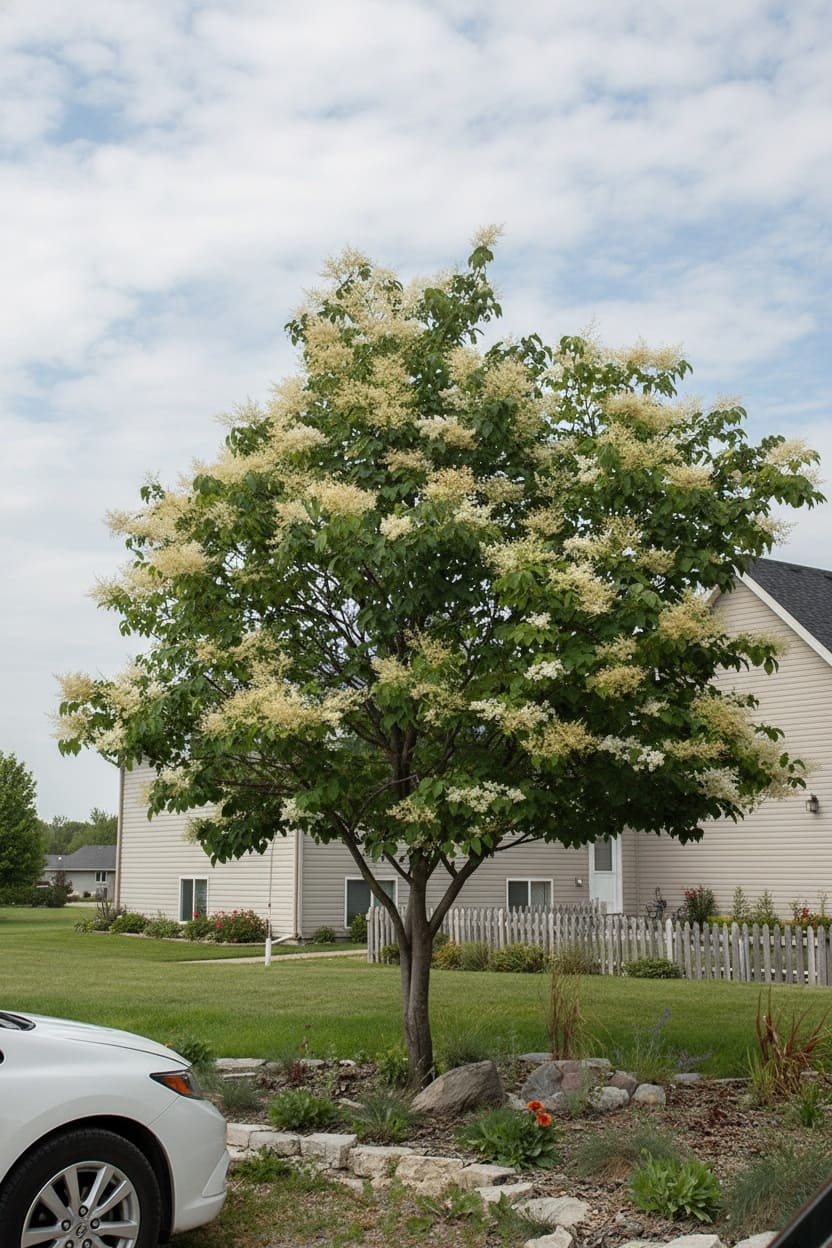
In late June through July, when most flowering trees have finished, this 20-30 foot tree produces large clusters of creamy white flowers with a honey-sweet fragrance.
The cherry-like bark peels attractively, providing winter interest. Unlike shrub lilacs, tree lilacs resist powdery mildew and handle heat better (zones 3-7).
The only caveat: Some find the fragrance overpowering (described as “privet-like” rather than traditional lilac scent). Plant away from patios and windows if fragrance sensitivity is a concern.
👉 Here’s How to Grow and Care for Lilacs: The Ultimate Guide For Beginners
Sourwood (Oxydendrum arboreum)
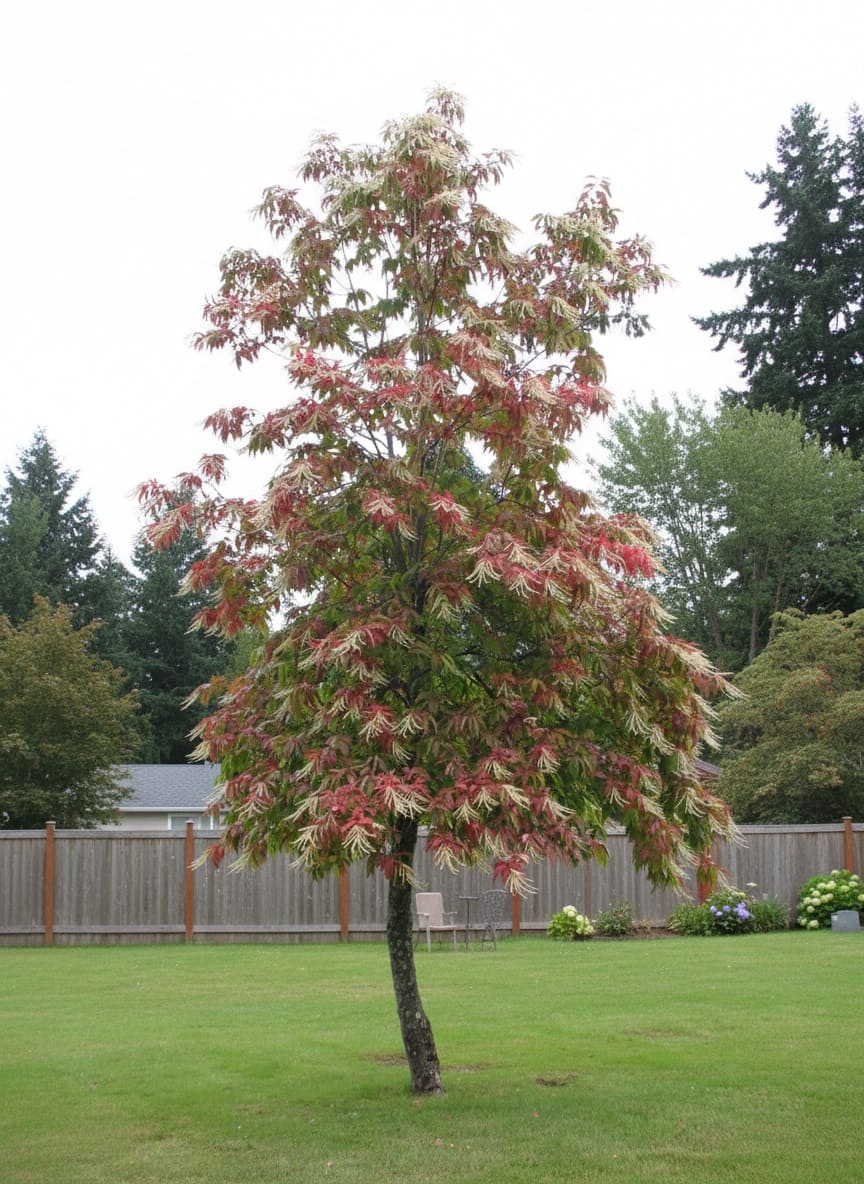
This native southeastern tree offers something different: fragrant white bell-shaped flowers in 6-10 inch drooping clusters during July and August.
The real showstopper arrives in fall when leaves turn brilliant scarlet weeks before other trees color up.
Reaching 25-30 feet, sourwood makes an excellent specimen for smaller landscapes (zones 5-9).
Sourwood demands acidic soil (pH 4.5-5.5) and won’t tolerate alkaline conditions. Test your soil before buying.
The slow growth rate means patience pays off with a long-lived, low-maintenance tree.
Golden Rain Tree (Koelreuteria paniculata)
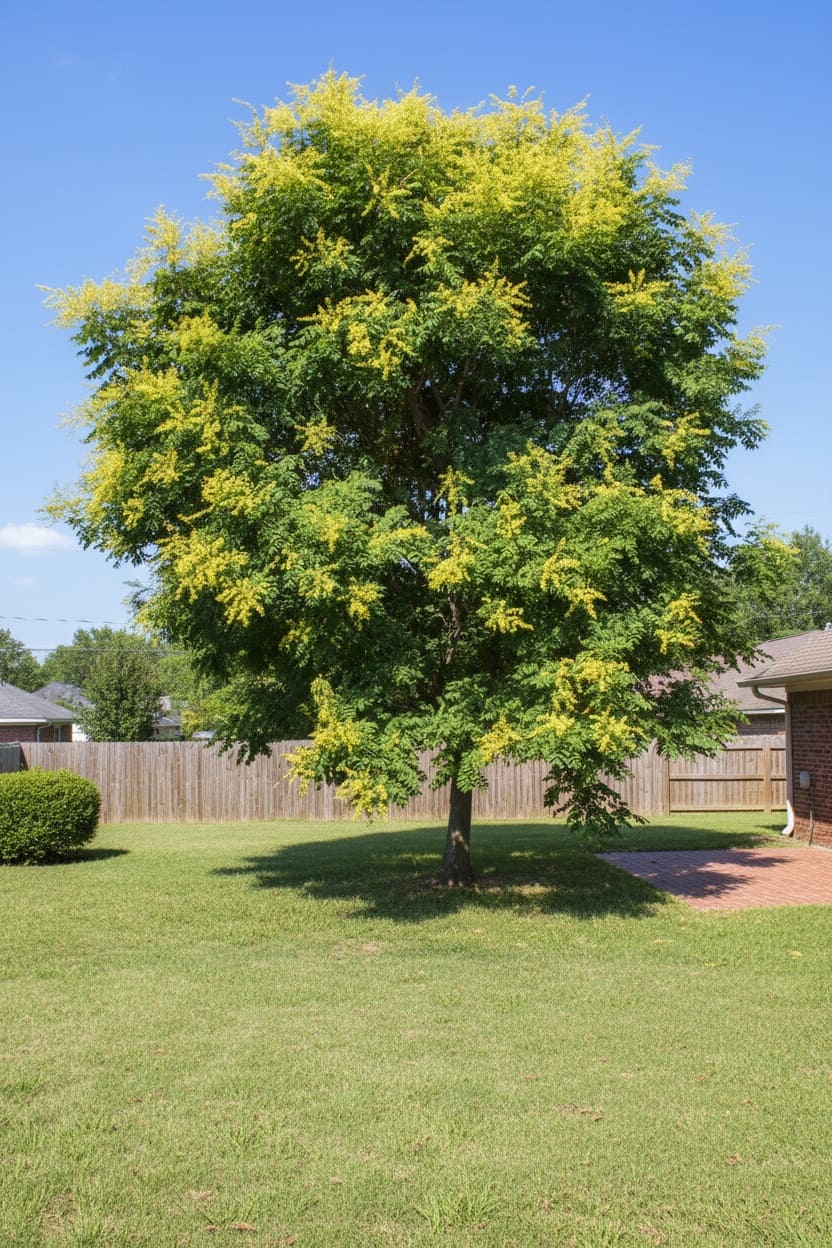
In July, large upright clusters of bright yellow flowers cover this 30-40 foot tree.
By late summer, the flowers transform into papery lantern-shaped seed pods that persist into fall, shifting from green to pink to brown.
The compound leaves turn golden-yellow in autumn (zones 5-9).
Golden rain tree handles urban pollution, compacted soil, drought, and heat—one of the toughest flowering trees available.
The only downside: self-seeds prolifically in ideal conditions and is considered invasive in some regions. Check local restrictions before planting.
Jacaranda (Jacaranda mimosifolia)
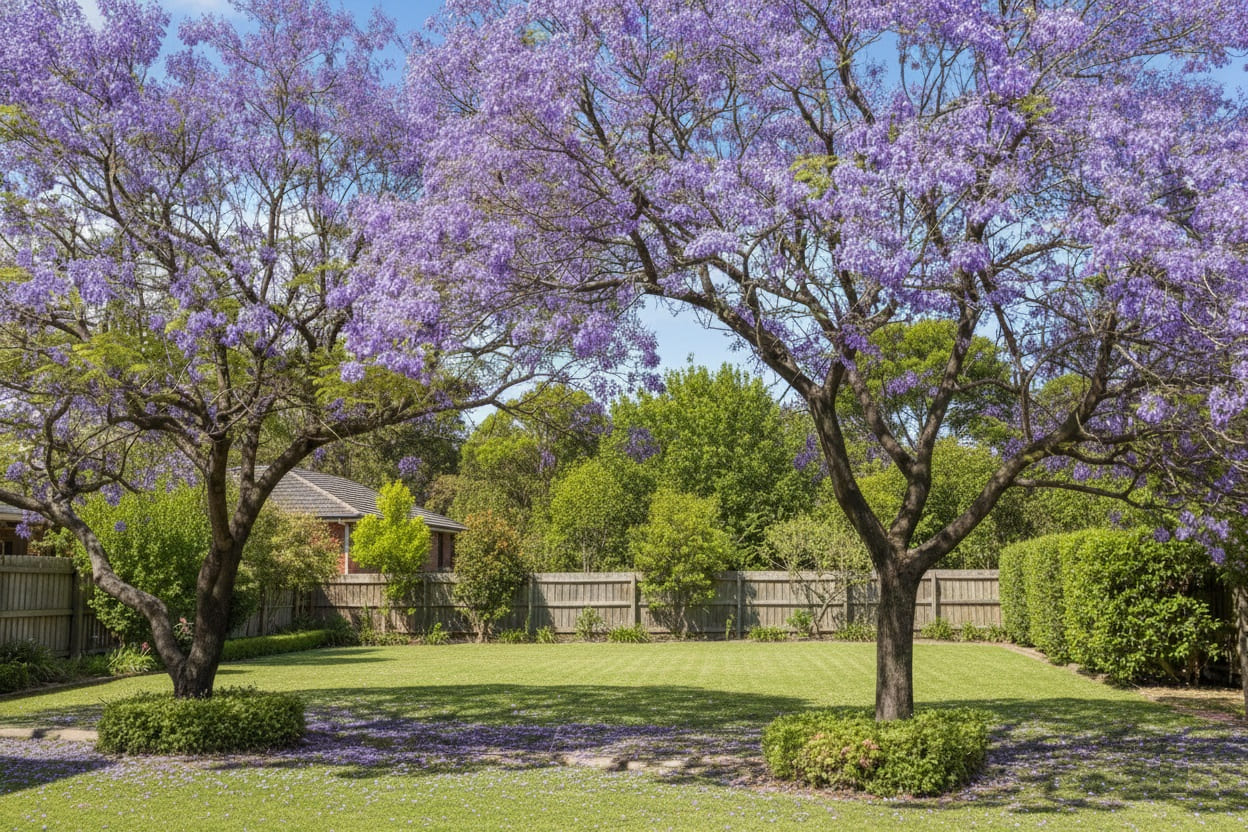
For warm-climate gardeners (zones 10-11, protected spots in zone 9), few sights rival a mature jacaranda in May through June.
Tubular lavender-blue flowers appear in such profusion they create a purple haze, and fallen petals carpet the ground below.
This large tree (40-50 feet) with fernlike foliage needs space but delivers unmatched tropical beauty.
The cleanup factor: Spent flowers, fallen leaves, and eventual seed pods require regular sweeping on patios and driveways. Plant away from high-traffic areas.
Stewartia (Stewartia pseudocamellia)
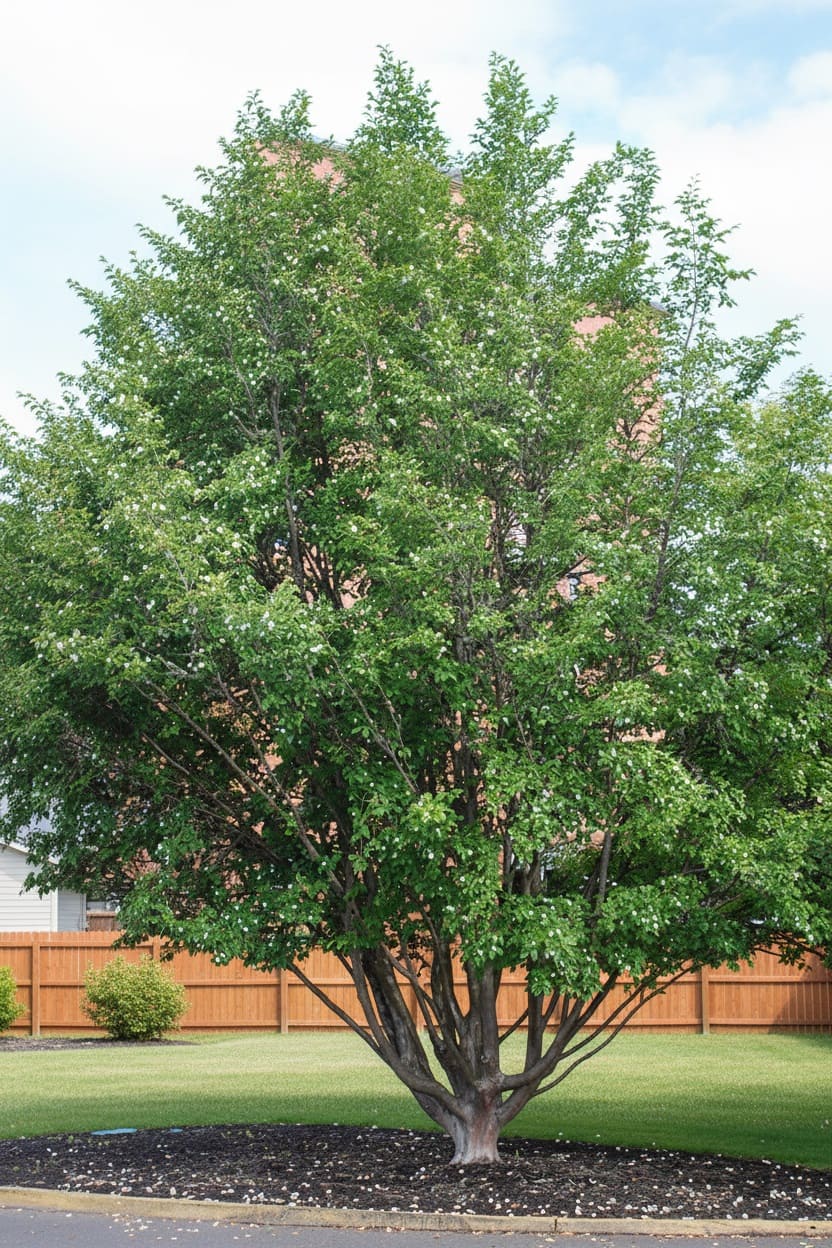
This elegant tree offers white camellia-like flowers with golden stamens in July, but the real treasure is its year-round beauty: bright green summer foliage, brilliant orange-red fall color, and exfoliating bark in patches of gray, orange, and reddish-brown.
Slow-growing to 20-40 feet (zones 5-8).
Stewartia’s secret: It’s one of the few flowering trees that actually prefers partial shade and acidic soil. Perfect for woodland gardens or as an understory tree beneath taller specimens.
Flowering Trees by Size: Finding Your Perfect Fit
Small Trees (Under 20 Feet)
Perfect for compact yards, container growing, or planting under utility lines.
Kousa Dogwood (Cornus kousa)
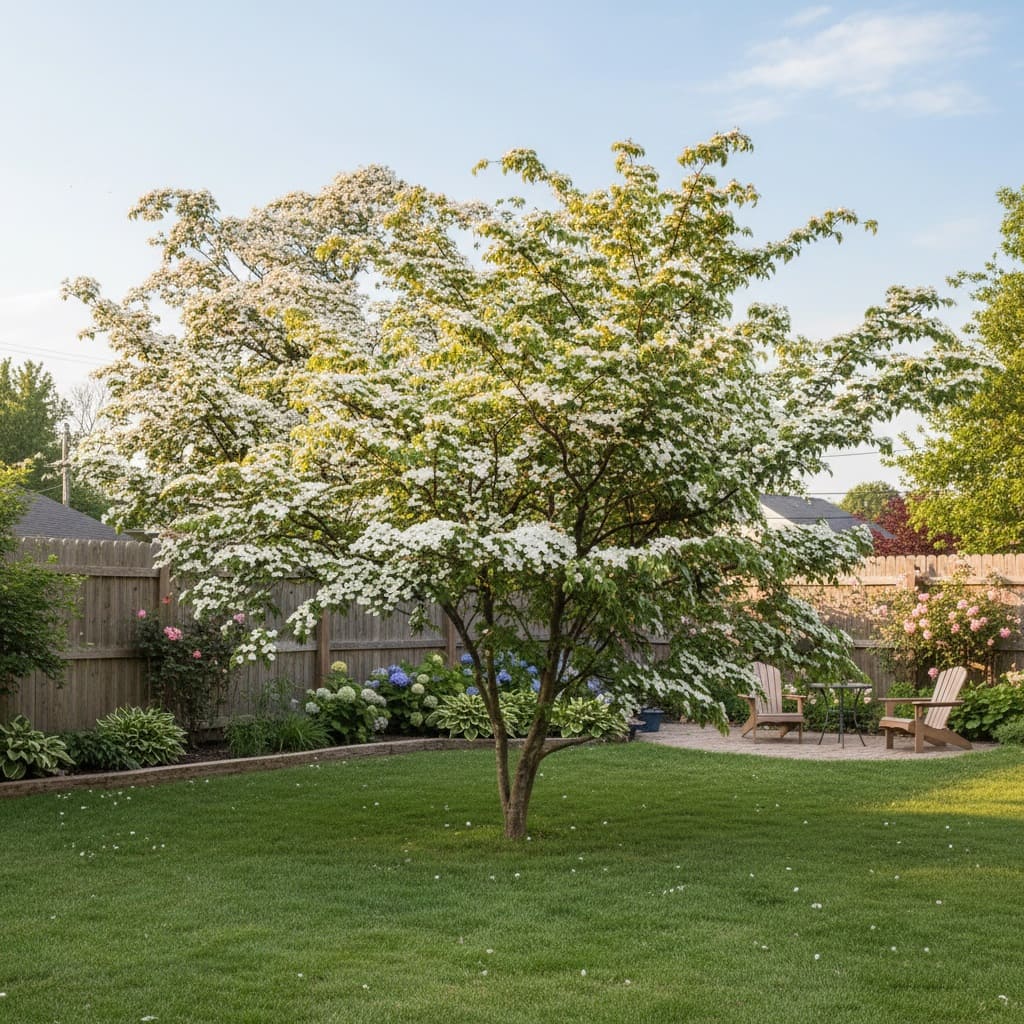
This Asian dogwood reaches 15-20 feet with white or pink bracts in June (later than flowering dogwood), raspberry-like fruits, and spectacular fall color.
The real advantage? Superior disease resistance compared to its American cousin. Zones 5-8.
Fringe Tree (Chionanthus virginicus)
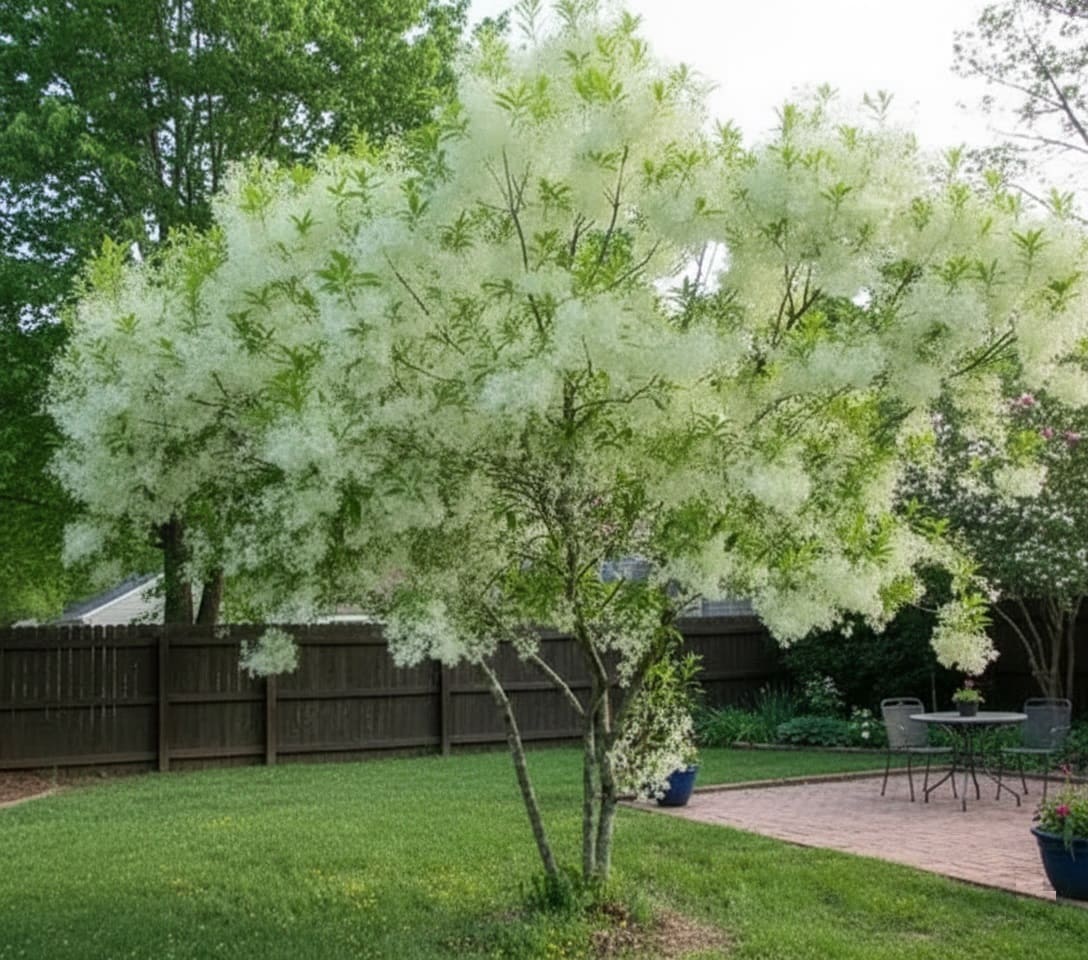
Fragrant white flowers hang like fringes in May-June on this native that grows slowly to 12-20 feet. The open, airy form casts light shade, perfect for underplanting. Adaptable to most soils (zones 4-9).
Japanese Snowbell (Styrax japonicus)
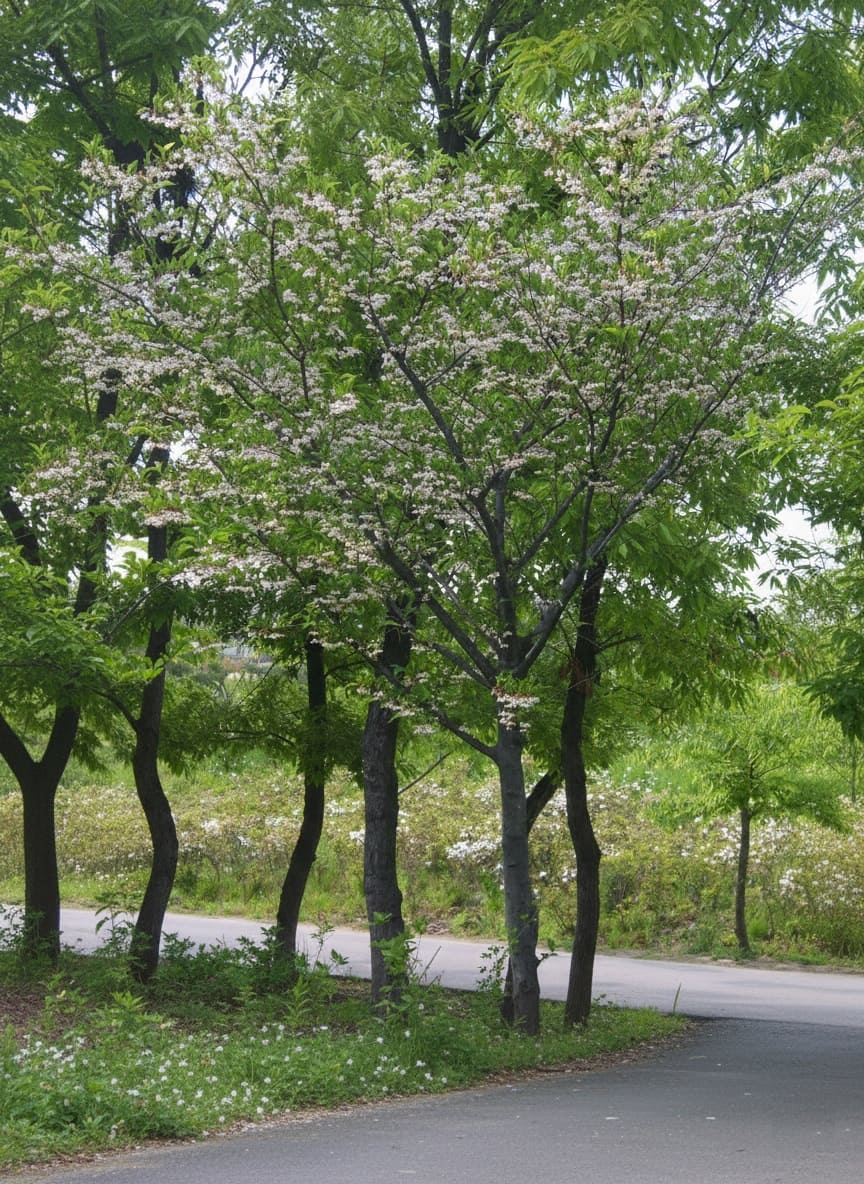
In June, fragrant white bell-shaped flowers dangle beneath branches like tiny bells.
This graceful 20-25 foot tree features a spreading, layered form perfect for viewing from below.
Plant near patios or decks where you can appreciate the downward-facing blooms. Prefers acidic soil and partial shade (zones 5-8).
Redbud Cultivars (Cercis canadensis varieties)
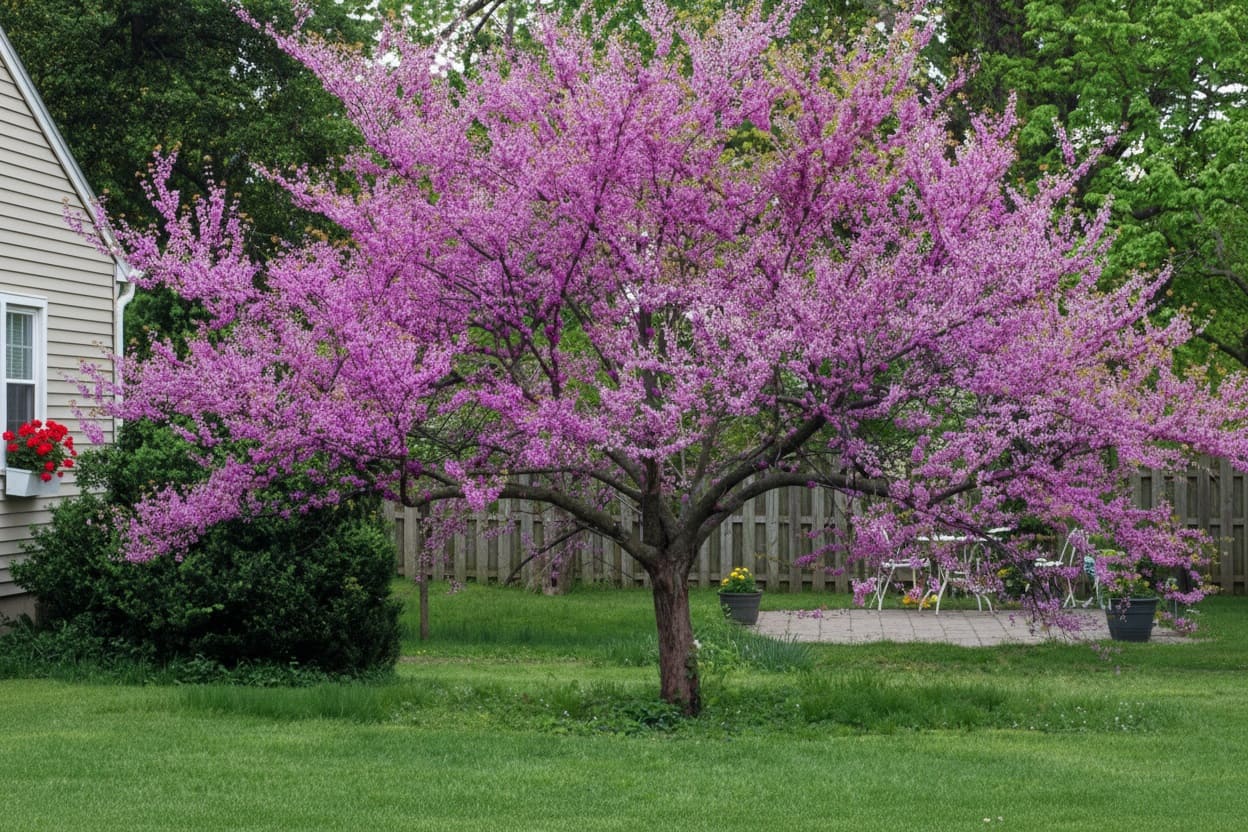
Beyond the species, cultivars like ‘Forest Pansy’ (15-20 feet, purple foliage), ‘Hearts of Gold’ (12-15 feet, chartreuse leaves), and weeping varieties like ‘Lavender Twist’ (5-8 feet) offer unique forms perfect for small spaces (zones 4-9).
Smokebush (Cotinus coggygria)
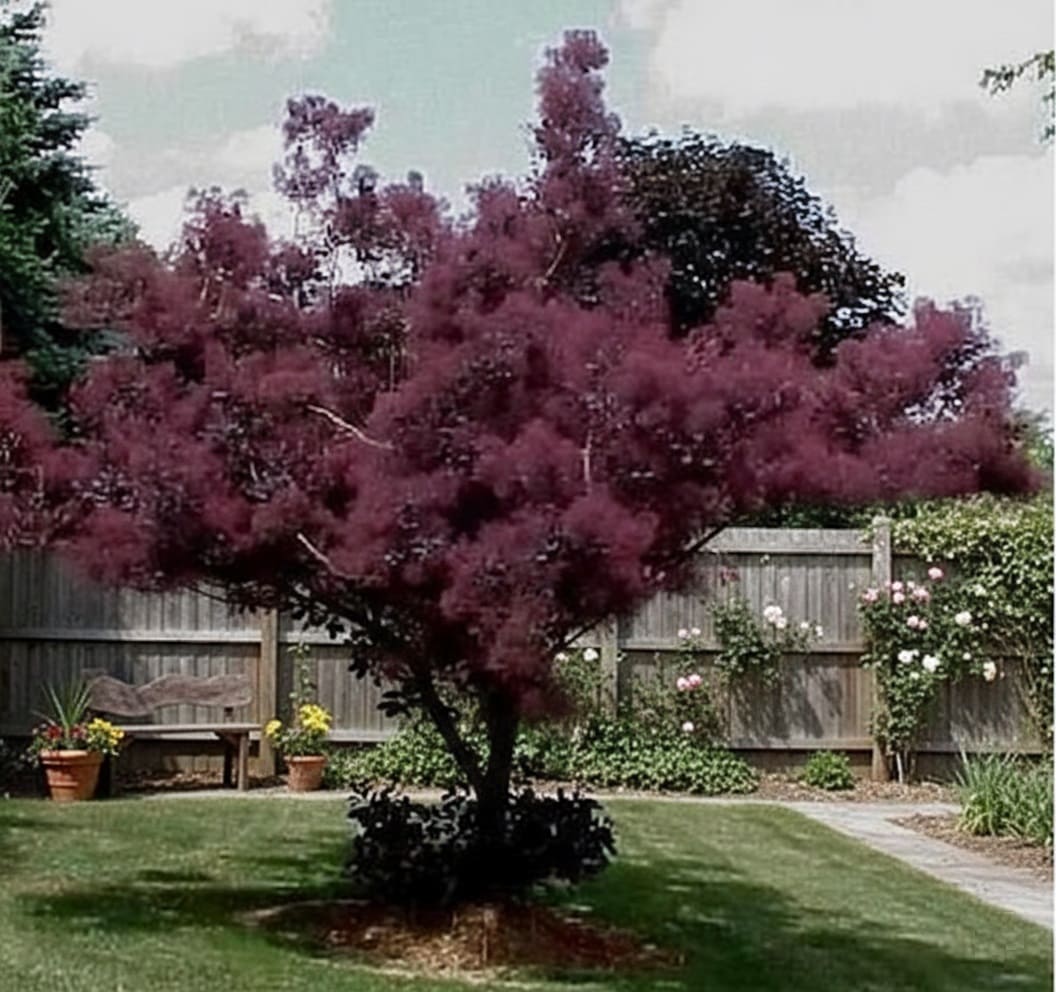
Though often grown as a large shrub, this can be trained into a small tree (10-15 feet).
Airy pink or purple “smoke” plumes appear in June and persist through summer.
Purple-leaved varieties like ‘Royal Purple’ provide season-long color (zones 5-8).
👉 Discover more Purple Leaf Plants To Transform Your Garden with Stunning Foliage
Medium Trees (20-40 Feet)
These fit most suburban lots while providing substantial presence.
Kwanzan Cherry (Prunus serrulata ‘Kwanzan’)
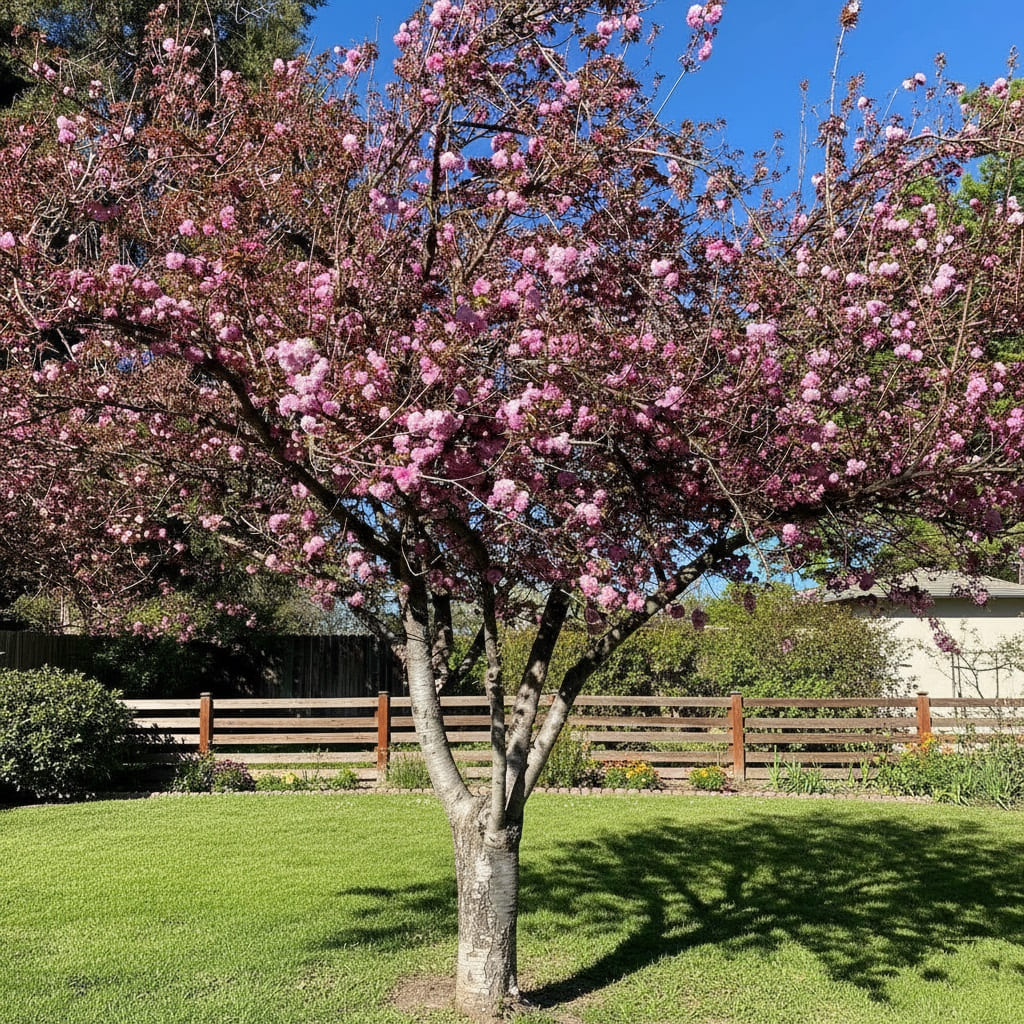
Double pink pompom flowers absolutely smother this 25-30 foot tree in mid-April through early May. The display lasts about two weeks—brief but unforgettable.
Fall color is variable; shallow roots need careful placement away from hardscapes (zones 5-9).
Red Horse Chestnut (Aesculus x carnea)
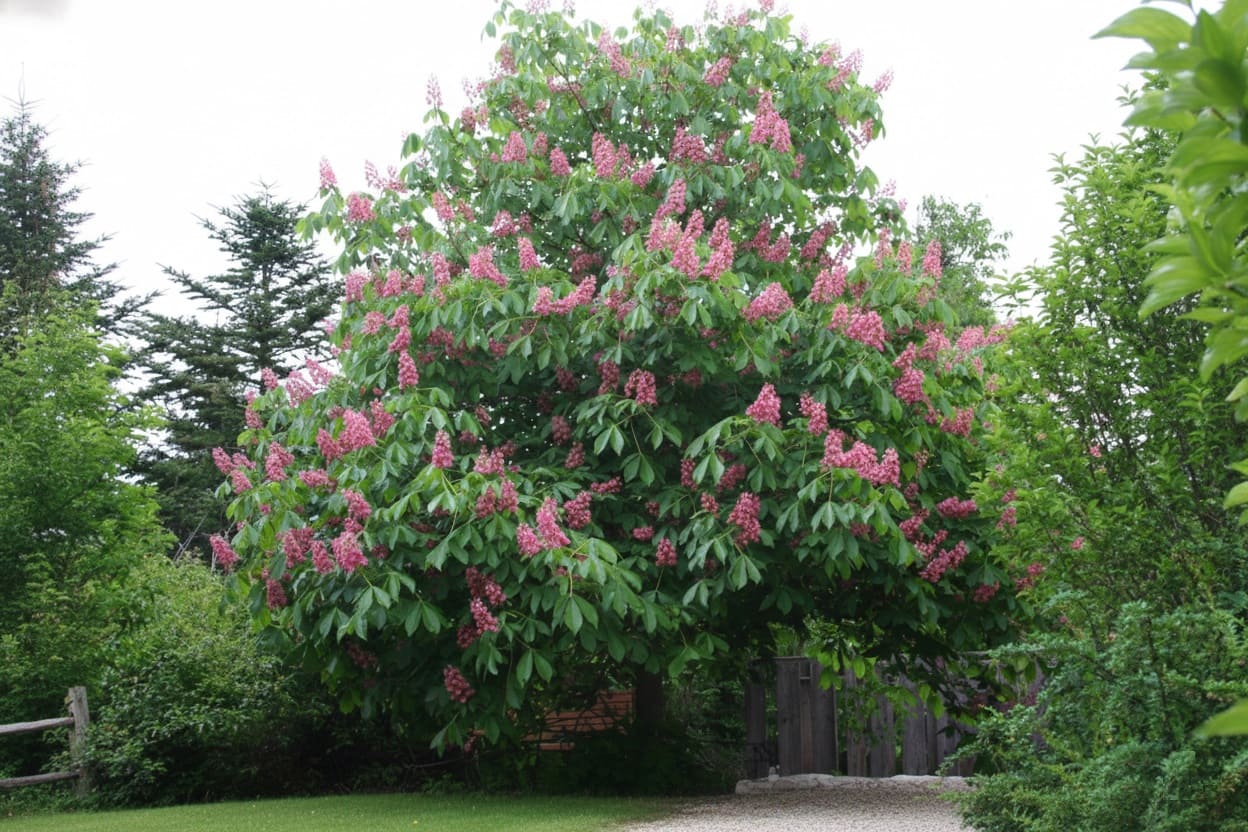
Upright spikes of pink-red flowers in May stand above the foliage like candles on this 30-40 foot rounded tree.
Attracts hummingbirds and handles urban conditions. Unlike common horse chestnut, the nuts are smaller and less messy (zones 4-8).
Catalpa (Catalpa speciosa)

In late May through June, large orchid-like white flowers with purple and yellow markings cover this 40-60 foot tree. By fall, distinctive long bean-like seed pods develop and persist through winter.
The huge heart-shaped leaves (8-12 inches across) create coarse texture and dense shade (zones 4-8).
Catalpa’s strength—fast growth and toughness—is also its weakness. Brittle wood breaks in storms, and fallen flowers, leaves, and seed pods create cleanup.
Best for low-maintenance areas where toughness matters more than tidiness.
Sweetbay Magnolia (Magnolia virginiana)
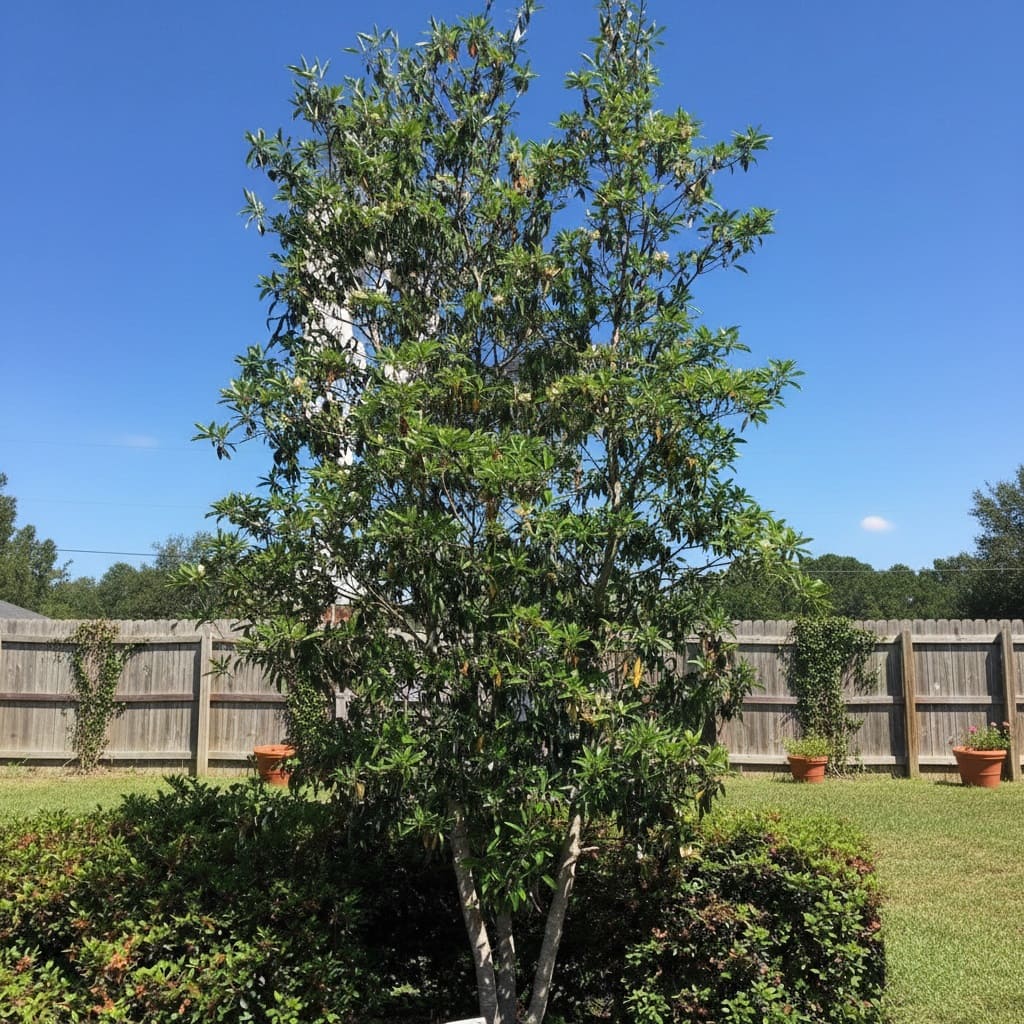
This semi-evergreen native (evergreen in warmer zones) reaches 20-35 feet with fragrant creamy-white flowers from May through summer.
Unlike Southern magnolia, it tolerates wet soil and partial shade. The silvery leaf undersides shimmer in the breeze (zones 5-10).
Perfect for challenging wet sites where other flowering trees struggle—near ponds, low areas, or poorly drained spots.
👉 Discover more Silver and Gray Foliage Plants for Stunning Gardens
Large Trees (40+ Feet)
For spacious properties where a statement tree makes sense.
Tulip Tree (Liriodendron tulipifera)

This native giant reaches 70-90 feet with a straight trunk and pyramidal form.
Greenish-yellow tulip-shaped flowers with orange centers appear in May-June, but you’ll need binoculars to see them up high.
Distinctive four-lobed leaves turn golden-yellow in fall. Fast-growing but needs space (zones 4-9).
American Yellowwood (Cladrastis kentukea)
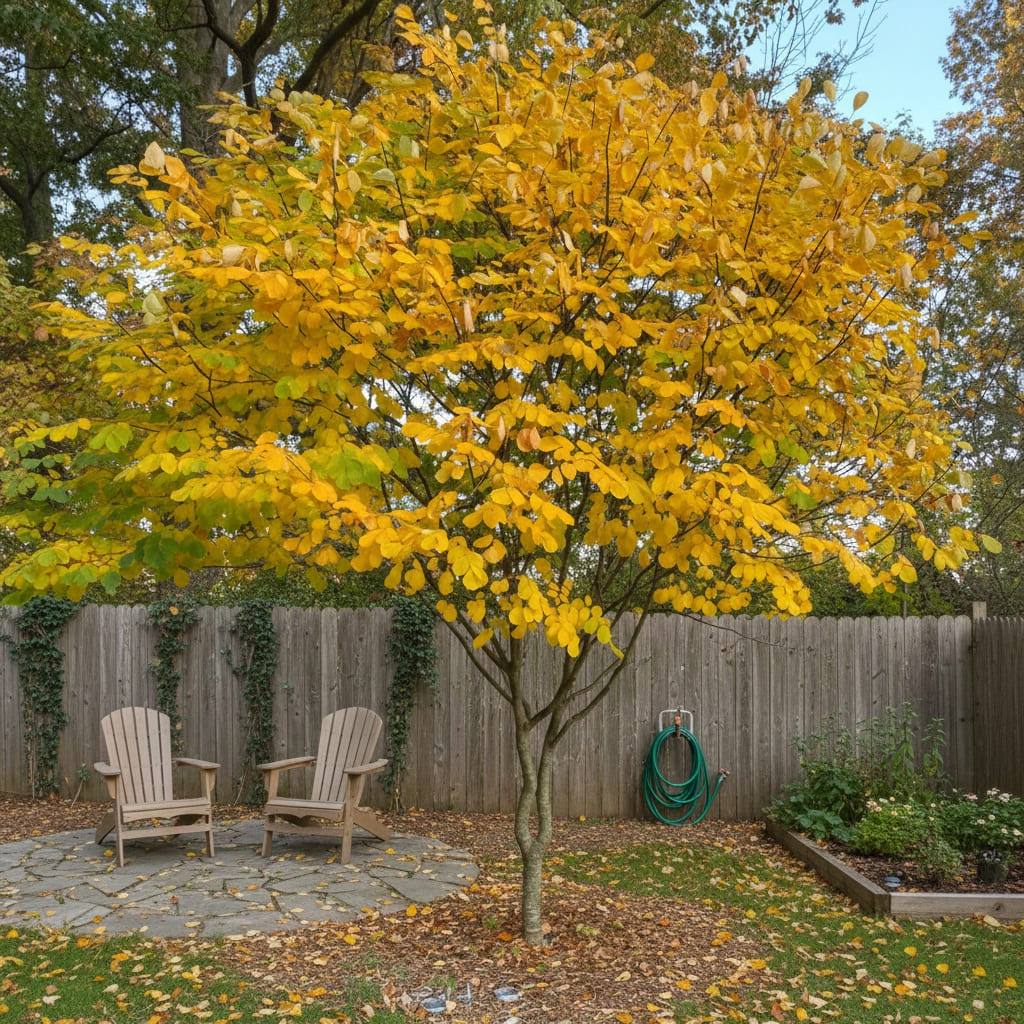
In late May to early June (on alternate years—it blooms heavily every other year), this 30-50 foot native produces cascading clusters of fragrant white flowers up to 14 inches long.
Smooth gray bark resembles beech, and fall brings golden-yellow foliage. The vase-shaped form and moderate size make it suitable for residential landscapes where tulip trees would overwhelm (zones 4-8).
- Yellowwood’s quirk:
Young trees may need staking to develop strong central leaders, as branches tend to grow at narrow angles that can split under stress.
Japanese Pagoda Tree (Styphnolobium japonicum, formerly Sophora japonica)
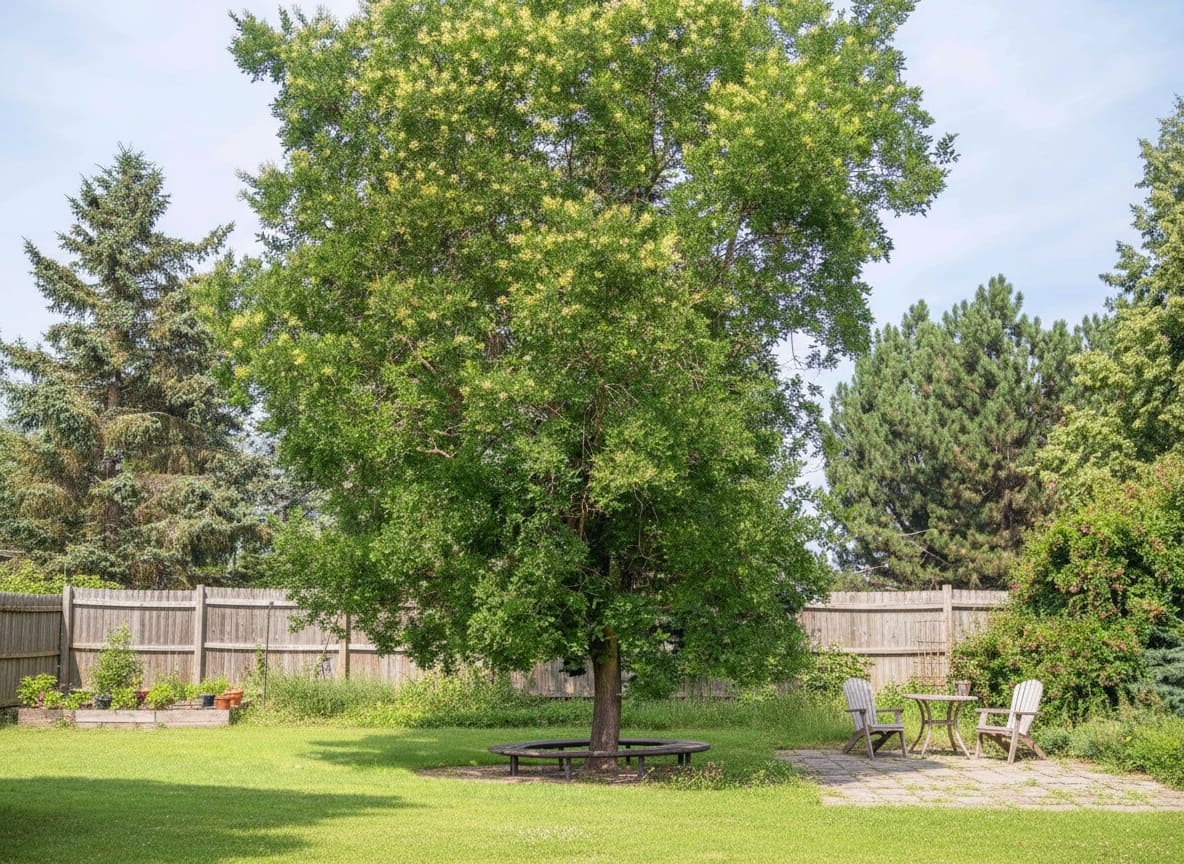
This 50-75 foot tree blooms in late July through August with large clusters of creamy-white pea-like flowers—valuable late-season nectar for pollinators.
Dark green compound leaves cast dappled shade, and the tree tolerates urban pollution, drought, and various soils (zones 4-8).
- The patience requirement:
Japanese pagoda trees take 10-15 years to begin flowering, but the long wait rewards with decades of late-summer blooms when few other trees flower.
Regional Climate Considerations Beyond Zones
Your hardiness zone matters, but successful tree selection requires understanding regional climate patterns:
- Humidity levels affect disease pressure
Powdery mildew and other fungal diseases thrive in humid regions (Southeast, Mid-Atlantic), making disease-resistant cultivars essential. In dry Western climates, these diseases are rarely problematic.
- Summer heat intensity varies even within zones
A zone 7 in the Pacific Northwest experiences cooler, moister summers than zone 7 in Oklahoma. Southern magnolias thrive in humid heat but struggle in dry heat.
- Rainfall patterns determine watering needs
Consistent summer rainfall in the East means established trees need little supplemental water. In the arid West, even “drought-tolerant” trees need deep monthly watering during summer.
- Microclimates in your yard create opportunities
That sheltered south-facing wall might let you grow a tree rated one zone warmer. A low-lying frost pocket might kill blooms on an otherwise hardy tree.
Talk to local nursery professionals and your county extension office. They know which trees truly thrive in your specific region, not just survive.
Essential Planting and Care Guide
Planting for Long-Term Success
- Timing determines establishment ease
Fall planting (September-November) lets roots establish before next summer’s stress.
Spring planting (March-April) works too but requires more vigilant watering through the first summer. Avoid planting during extreme heat or frozen ground.
- Dig a proper hole
Make it 2-3 times wider than the root ball but no deeper—this is crucial. The top of the root ball should sit level with or slightly (1-2 inches) above ground level.
Planting too deep suffocates roots and kills more trees than pests and diseases combined.
- Handle container-grown trees carefully.
If roots circle the container, score them vertically with a knife in 3-4 places and tease them outward.
Circling roots continue that pattern underground, eventually girdling and killing the tree.
- Water deeply at planting
Soak the entire root zone until water puddles, then let it drain.
Apply 2-3 inches of organic mulch (shredded bark or wood chips) in a donut shape—extending to the drip line but pulled 3-4 inches back from the trunk.
Mulch conserves moisture, moderates soil temperature, and suppresses weeds.
First-Year Care: Make or Break Time
New trees need consistent attention for 12-18 months:
- Water schedule
Provide 1 inch of water weekly (from rain or irrigation) throughout the first growing season. Deep, less-frequent watering encourages deep roots.
Shallow, frequent watering creates weak, surface roots vulnerable to drought and wind damage.
Check soil moisture 3-4 inches deep. If it’s dry, water slowly and deeply—run a soaker hose for 30-60 minutes or let a regular hose trickle for hours.
Clay soil needs less frequent but longer watering sessions than sandy soil.
- Skip fertilizer initially
Newly planted trees focus energy on root growth. Fertilizer pushes top growth before roots can support it, creating weak, stressed trees. Wait until the second growing season, then fertilize lightly only if growth seems slow.
- Staking controversy
Most trees don’t need staking. It can actually weaken trunk development.
Stake only if planting in extremely windy sites or with top-heavy specimens, using flexible ties that allow some trunk movement. Remove stakes after one year maximum.
Ongoing Maintenance for Established Trees
- Pruning timing matters critically:
The rule depends on bloom timing:
1. Spring bloomers (cherry, magnolia, redbud, dogwood, crabapple, serviceberry, hawthorn, golden chain tree) set flower buds the previous summer.
Prune immediately after flowering finishes—you have roughly a 6-week window. Pruning in winter removes those precious flower buds.
2. Summer bloomers (crape myrtle, chaste tree, Japanese tree lilac, golden rain tree) bloom on new spring growth.
Prune in late winter before growth begins, which actually encourages more flowering branches.
3. Dead, damaged, diseased wood: Remove anytime you notice it, regardless of season.
- Annual mulch refresh:
Replenish mulch each spring to maintain a 2-3 inch layer. Keep it pulled back from the trunk—”volcano mulching” (piling mulch against the trunk) creates moisture and disease problems that kill established trees.
- Watering established trees:
After the first year or two, most trees handle normal rainfall. During extended droughts (3+ weeks without rain), provide deep watering even to established trees, especially when they’re setting next year’s flower buds in mid to late summer.
Common Pest and Disease Issues
While we’ve emphasized disease resistance, here are common problems to watch for:
- Aphids love new tender growth in spring. Minor infestations don’t harm trees—beneficial insects usually control them. For heavy infestations, spray off with water or use insecticidal soap.
- Japanese beetles skeletonize leaves on some trees, especially crabapples and cherries. Hand-pick early morning when beetles are sluggish, or use targeted insecticides if damage is severe.
- Scale insects appear as small bumps on bark and branches. Horticultural oil applied during dormant season smothers overwintering scales.
- Powdery mildew creates white coating on leaves, primarily cosmetic on trees (worse on crape myrtles in humid regions). Choose resistant cultivars to avoid this issue.
- Fire blight affects crabapples and hawthorns, causing branches to look scorched. Prune affected branches 12 inches below damage during dry weather, sterilizing pruners between cuts. Choose resistant varieties when possible.
👉 Find out Why Paint Tree Trunks White? A Guide to Whitewashing for Tree Protection
Special Considerations for Specific Needs
Best Low-Maintenance Champions
For gardeners wanting beauty without babysitting:
- Eastern redbud, serviceberry, and fringe tree—all natives—need virtually no care once established.
- Kousa dogwood offers ornamental appeal with minimal disease pressure.
- Older crape myrtle cultivars don’t even need annual pruning, though many gardeners prune anyway for size control.
- Yellowwood, once established, essentially takes care of itself for decades.
Creating Wildlife Habitat
Layer early, mid, and late-season bloomers for continuous pollinator support:
- Early: Serviceberry, redbud, cornelian cherry (March-April nectar)
- Mid: Hawthorn, crabapple, black locust (May flowers, persistent fruits)
- Late: Crape myrtle, chaste tree, Japanese tree lilac, sourwood (summer nectar when few trees bloom)
Native species support more wildlife than exotic ornamentals. A native crabapple hosts over 300 butterfly and moth species; an exotic ornamental cherry hosts fewer than 10.
Dealing with Deer Pressure
Deer devour certain trees while avoiding others:
- Deer candy: Redbud, fruit trees, most cherries, serviceberry
- Deer resistant: Fringe tree, magnolias, crape myrtle, dogwoods (usually), golden chain tree, sourwood
In high-pressure areas, protect young trees with fencing until established. Once trees grow above browsing height (6-7 feet), they’re usually safe.
Trees for Difficult Sites
- Wet, poorly drained soil: Sweetbay magnolia, serviceberry, river birch (though not showy flowers)
- Dry, drought-prone areas: Crape myrtle, chaste tree, golden rain tree, smoke tree, catalpa
- Urban pollution and compacted soil: Hawthorn, golden rain tree, Japanese tree lilac, catalpa, callery pear (though increasingly restricted as invasive)
- Alkaline soil: Hawthorn, crabapple, golden rain tree
- Acidic soil lovers: Sourwood, stewartia, sweetbay magnolia, dogwoods
What to Expect: Timeline for Success
Setting realistic expectations prevents disappointment:
- Year 1: Focus on establishment, not beauty. Trees often look stressed as they adjust. Some flowering trees (cherries, redbuds, crabapples) may bloom lightly; others (magnolias, yellowwood) may skip flowering entirely.
- Years 2-3: Noticeable growth begins. Spring bloomers typically flower well; summer bloomers fill out.
- Years 4-5: Most trees hit their stride with profuse flowering and healthy growth.
- Years 10+: You’ll finally understand the “mature size” listed on the label. Trees develop character—interesting bark, full canopies, and maximum flower displays.
Lifespan varies widely:
- Flowering plum (15-20 years)
- cherries (20-30 years)
- redbuds (20-30 years)
- golden chain tree (30-40 years)
- crabapples (30-50 years)
- dogwoods (40-80 years)
- magnolias (80-120 years)
- sourwood and yellowwood (100+ years).
Choose accordingly based on whether you want fast impact or legacy planting.
Critical Mistakes to Avoid
- Planting too close to structures
That 6-foot nursery tree labeled “mature spread: 30 feet” needs its trunk positioned 15+ feet from buildings, driveways, and property lines. Measure now, avoid expensive mistakes later.
- Ignoring invasive species lists
Some states restrict certain trees (Bradford pear, Norway maple, some cherries, golden rain tree in some areas) due to invasive tendencies. Check local regulations before buying. Your county extension office maintains lists.
- Expecting instant maturity
Trees grow slowly. A 15-foot mature height means 10-15 years from planting, not 2-3 years. Buying a larger specimen tree (8-10 feet) costs more but looks established sooner.
- Over-mulching
More is not better. Piles of mulch against trunks create moisture and disease problems. Think donut, not volcano—3 inches deep maximum, pulled back from the trunk.
- Assuming all flowering trees fruit messily
Cherries, crabapples, and catalpas drop fruit and seed pods. Magnolias drop petals and seed cones.
But redbuds, dogwoods, crape myrtles, and smokebush? Minimal mess. Ask about cleanup before buying if this matters to you.
FAQ: Your Questions Answered
- Q: When will my newly planted tree bloom?
Depends on the tree’s age and type. Container-grown trees (3-5 years old) often bloom the first spring. Younger bareroot or seedling trees may take 3-5 years to flower well.
Some trees like Japanese pagoda tree won’t bloom for 10-15 years, while redbuds often bloom within 3-4 years. Stress from transplanting can delay blooming by a year.
- Q: Why didn’t my tree bloom this year?
Late frost killed developing buds, improper pruning removed flower buds, insufficient sun (most need 6+ hours), drought stress the previous summer when buds were forming, excessive nitrogen fertilizer promoted leaf growth over flowers, or the tree is in an “off year” (some species like yellowwood bloom heavily every other year).
- Q: Can I grow flowering trees in containers?
Yes, if you choose dwarf cultivars and use minimum 20-gallon containers with excellent drainage.
Containerized trees need consistent watering (sometimes daily in summer), annual fertilizing, and repotting every 3-4 years.
Best bets: dwarf crape myrtles, compact magnolias, small crabapples, weeping redbuds like ‘Lavender Twist.’
- Q: How much do flowering trees cost?
Nursery prices vary by size: 3-4 foot whips ($25-50), 6-8 foot container trees ($75-150), 10-12 foot balled-and-burlapped specimens ($200-500+).
Larger isn’t always better—younger trees establish faster with less transplant shock.
- Q: Do flowering trees need cross-pollination?
Matters only if you want edible fruit. Serviceberries, crabapples, and some cherries fruit better with a second variety nearby.
Ornamental trees grown purely for flowers don’t need pollinators. If fruit is your goal, ask nursery staff about pollination requirements.
- Q: Which flowering trees have the longest bloom period?
Crape myrtle wins with 3-4 months of continuous blooms (June-September). Southern magnolia blooms sporadically May-August.
Chaste tree flowers June-September. Most other flowering trees bloom for 1-3 weeks, making multiple-tree selection important for extended color.
Start Your Flowering Tree Journey
Choosing the right flowering tree transforms your landscape for decades. Unlike annuals requiring yearly replanting, your tree grows more beautiful each season, eventually becoming a treasured landmark.
Your action plan:
- Identify your hardiness zone and regional climate pattern
- Measure your planting area carefully—height and width
- Test your soil or at least observe its drainage after rain
- Visit local nurseries to see actual specimens, not just photos
- Ask professionals which trees thrive (not just survive) in your specific area
- Choose disease-resistant cultivars whenever available
- Plant properly—width over depth, proper mulching, consistent first-year watering
The small investment of research time now prevents expensive mistakes and delivers decades of beauty.
Start by identifying 2-3 trees that match your conditions, then visit nurseries to see which speaks to you.
What will you plant? Share your choice in the comments, or tell us about a flowering tree already stealing the show in your yard.
And if you found this guide helpful, save it for reference—you’ll want it when planting season arrives.
Happy planting—may your yard bloom brilliantly season after season!

