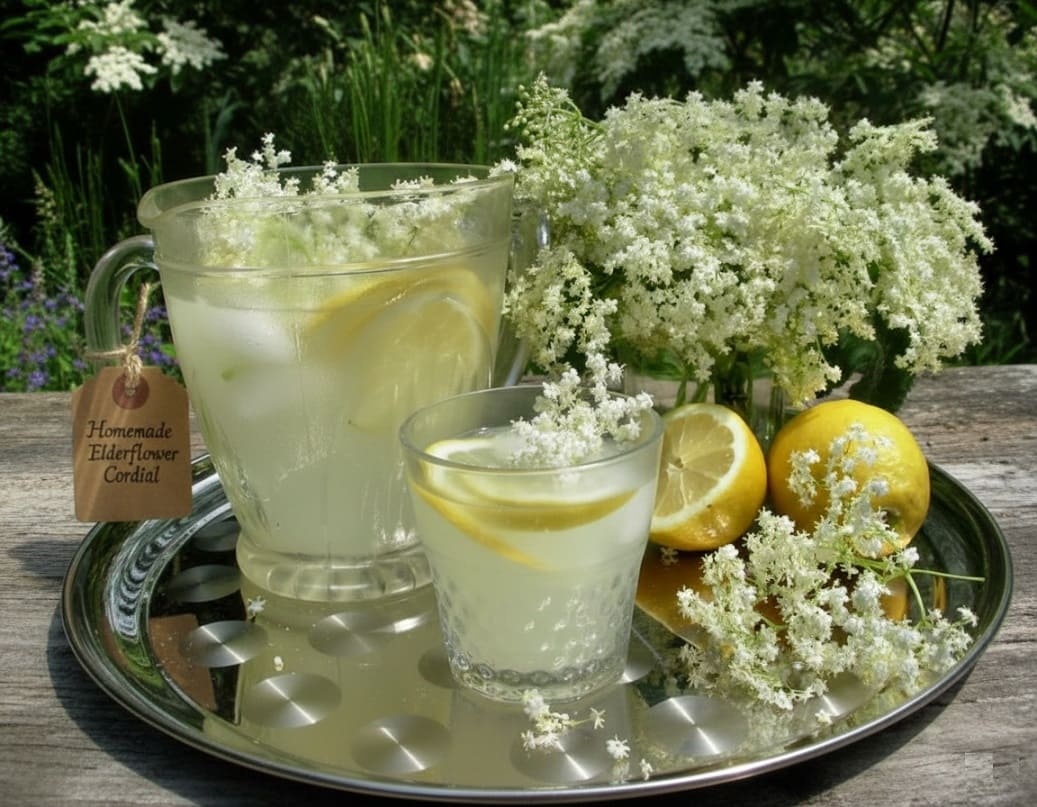
I’ll never forget the first time I tasted elderflower cordial. It was a sweltering June afternoon, and a friend handed me a tall glass filled with ice, sparkling water, and just a splash of something golden.
One sip, and I was hooked—that distinctive floral sweetness with hints of lychee and honey, finishing with a bright citrus note.
When she told me she’d made it herself from flowers picked from the lanes near her cottage, I knew I had to learn.
That was five years ago. Now every spring I eagerly watch the hedgerows, waiting for those creamy white blooms to appear.
Making elderflower cordial has become a ritual that marks the beginning of summer—a way to capture sunshine in a bottle.
This guide will walk you through everything you need to know, from identifying the right flowers to troubleshooting common problems.
Whether you’re completely new to foraging or looking to perfect your technique, you’ll finish this post ready to create your own batch of this magical summer syrup.
Understanding Elderflowers and Why They’re Worth Finding
Elderflower (Sambucus nigra) blooms for just a few precious weeks each year, typically from late May through early July.
The timing shifts with geography—southern regions see blooms as early as late May, while northern areas might not see them until mid-June. This brief window makes the tradition of cordial-making feel special and seasonal.
The flavor is genuinely unique: intensely floral with notes of honey and tropical lychee, ripe pear, and subtle herbaceous undertones.
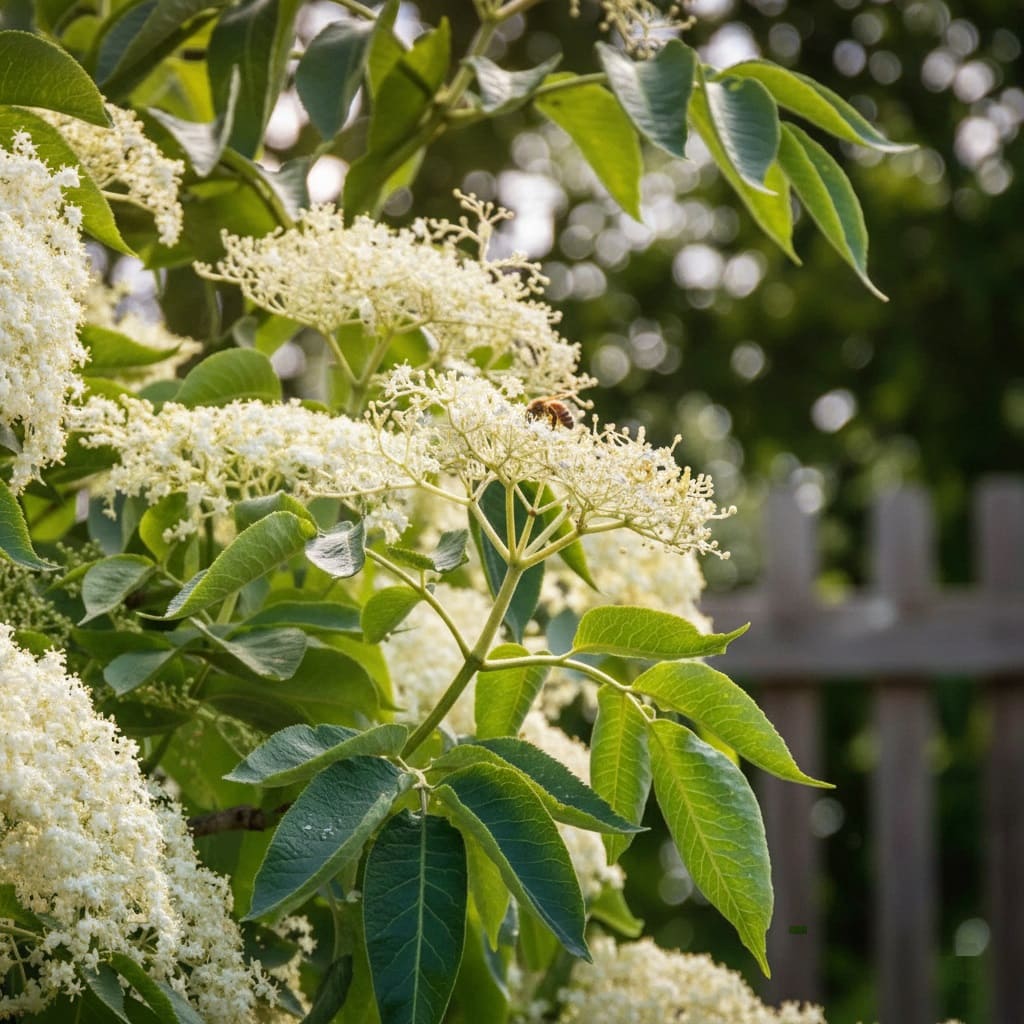
Here’s something fascinating—those flowers that smell oddly musky (some say “catty”) on the tree undergo complete transformation when combined with sugar and citrus.
The cooking process brings out sweet, honeyed qualities while any unpleasant notes vanish entirely.
- An important safety note:
While elderflowers are perfectly edible, other parts of the elder plant contain compounds that are mildly toxic. The thick green stems, leaves, unripe berries, bark, and roots should never be consumed.
This is why properly removing the flowers from their stems isn’t just about flavor—it’s about safety. The delicate flower stems are fine in small amounts, but always remove the thick, woody parts.
👉 Read The Complete Guide to Edible Flowers: 25+ Varieties to Grow & Cook
Finding and Identifying Elder Trees
Elder grows as a small, scrubby tree or large shrub throughout Europe, North America, and temperate regions worldwide.
You’ll find them along roadsides, in hedgerows, woodland edges, waste ground, and even urban parks.
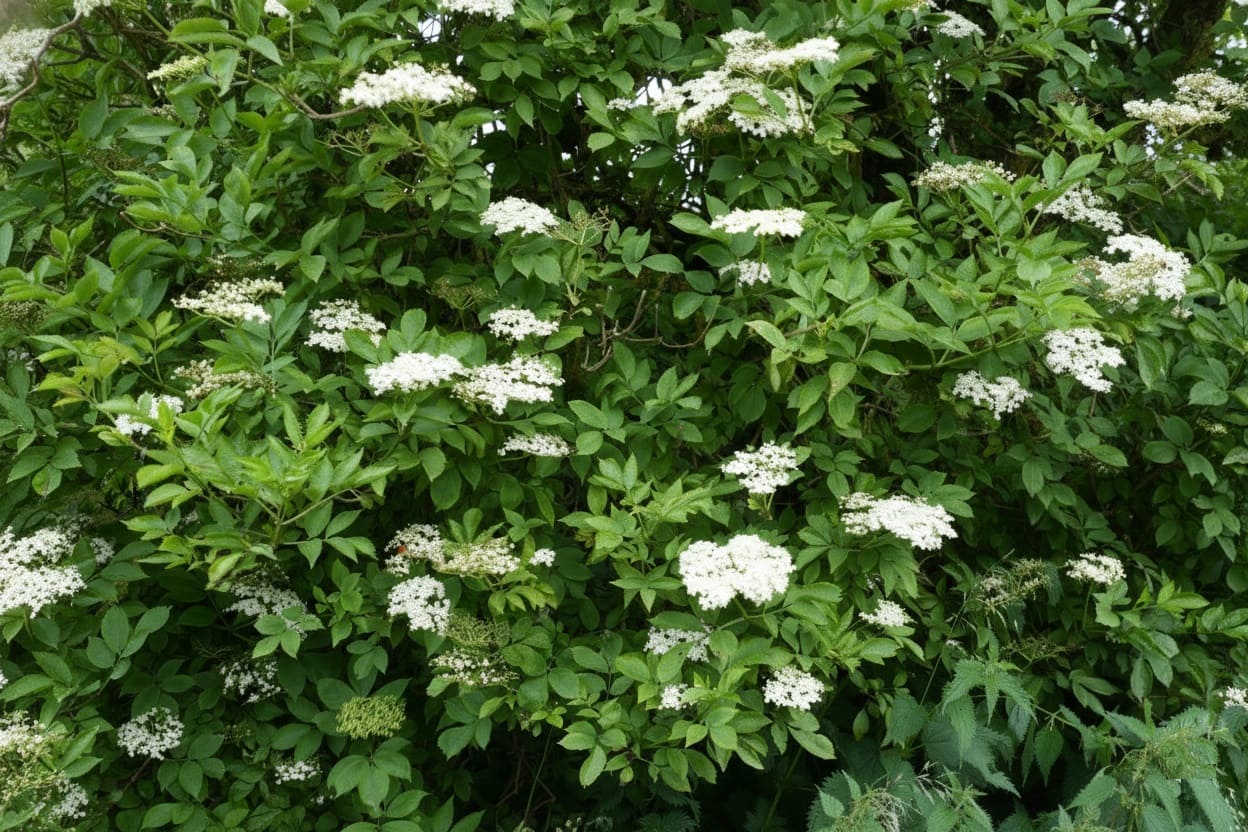
Look for these identifying features: Leaves arranged in groups of 5-7 oval leaflets with serrated edges.
The flowers appear in flat-topped clusters called umbels, measuring 10-25cm across, made up of hundreds of tiny cream-colored flowers, each with five petals.
The characteristic musky-sweet fragrance is your final confirmation—though don’t rely on smell alone.
Critical warning: Never pick anything you’re not 100% certain about.
- Hemlock, which is highly poisonous, has umbrella-like white flowers but features purple-spotted stems and lacks the elderflower’s sweet scent.
- Cow parsley also has white flowers but grows from the ground rather than tree branches.
When in doubt, consult an expert forager or botanical guide.
The Art of Picking: When, Where, and How
The best elderflower cordial comes from flowers picked at exactly the right moment in exactly the right conditions. Here’s what that means in practice:
Timing matters enormously
Pick on a dry, sunny morning after any dew has evaporated but before the afternoon heat. I typically head out around 10-11am on sunny days.
The flowers’ essential oils are most concentrated at this time—pick in early morning and they’re damp with dew, too late in the afternoon and the scent can turn unpleasant.
Look for flowers that are fully open
The blooms should be creamy white, not greenish buds or browning flowers going to seed.
If you see what looks like tiny white hundreds and thousands clustered tightly, wait a day or two until they’ve properly opened into distinct flowers.
Once flowers start browning, they’re past their prime and heading toward becoming berries.
Where you pick is as important as when
Avoid flowers growing within 50 meters of busy roads—they’ll be coated in exhaust residue.
Similarly, skip areas near agricultural fields that might be sprayed with pesticides, industrial sites, or anywhere dogs frequently visit.
The best spots are quiet country lanes, established hedgerows away from traffic, and woodland edges.
Practice responsible foraging
Only pick from trees where you have permission or that are on public land.
Take no more than one-third of the flowers from any single tree, and spread your harvest across multiple trees.
Leave plenty to develop into berries—they’re a crucial autumn food source for birds and you might want to make elderberry syrup yourself come September.
👉 Discover 40+ Types of Berries: Identification Guide, Health Benefits & How to Grow
The Essential Recipe: Traditional Method with Modern Refinements
After testing numerous variations and studying techniques from across the elderflower cordial-making world, here’s the recipe that balances traditional methods with practical modern preferences.
What You’ll Need
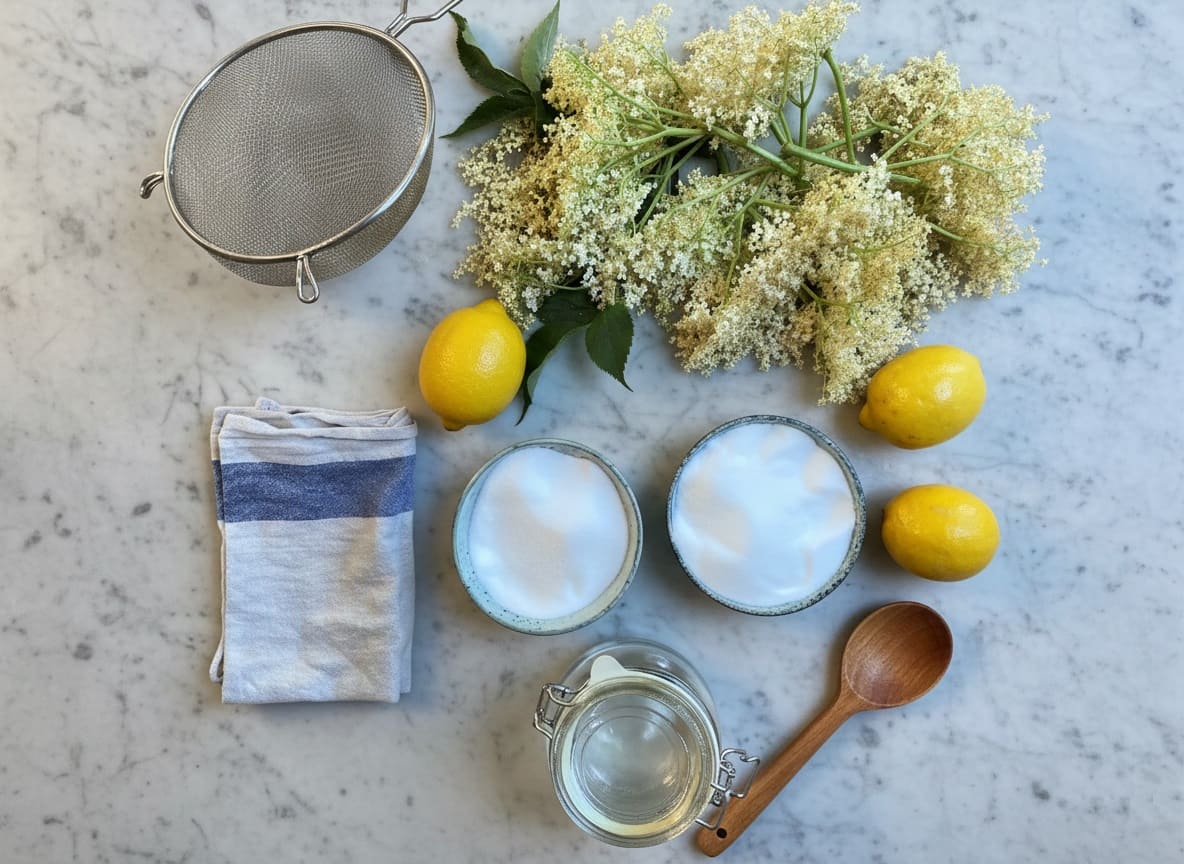
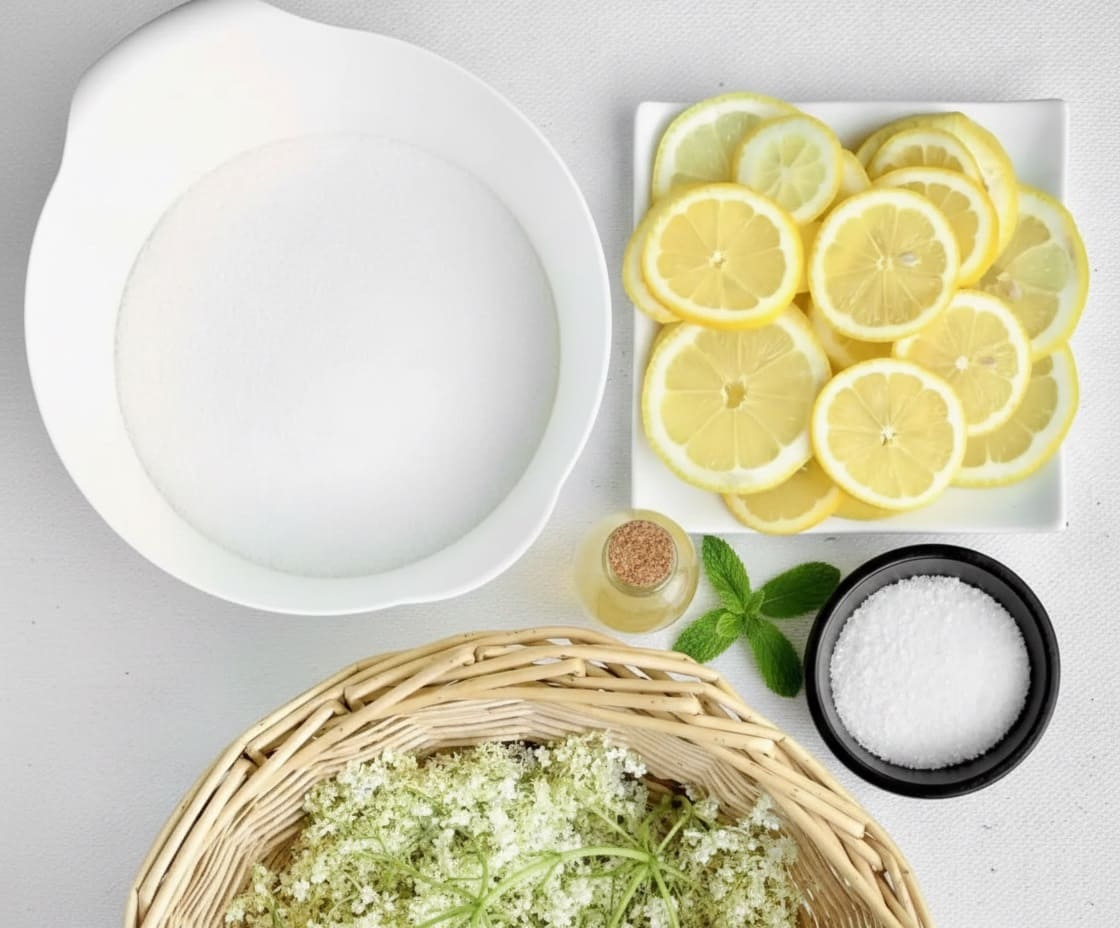
Ingredients (makes approximately 2-2.5 liters):
- 20-25 large elderflower heads (or 30-35 small ones—about 1 liter when loosely packed)
- 1 kg granulated or caster sugar
- 1.5 liters water
- 3 unwaxed lemons, or regular lemons scrubbed clean with hot soapy water
- 25-50g citric acid (see detailed note below on whether to include this)
Equipment:
- Large saucepan or preserving pan
- Large heatproof bowl
- Fine mesh sieve
- Muslin cloth, jelly bag, or very clean tea towel
- Glass bottles with tight-fitting lids (swing-top or screw-cap)
- Funnel
- Potato peeler or zester
About bottle sizes:
I recommend using bottles in the 250-500ml range rather than very large bottles.
Smaller bottles fit more easily in the fridge, and once opened, you’ll finish them before spoilage becomes a concern.
Save wine bottles, juice bottles, or purchase swing-top bottles designed for preserving.
The Step-by-Step Process
Total time commitment: 30 minutes active work, 24-48 hours steeping time
Day 1 Morning: Prepare and Steep (30 minutes active time)
1. Start by preparing your elderflowers. Gently shake each head to dislodge any insects—you want them to escape, not become part of your cordial.
Don’t wash the flowers; you’ll lose the precious pollen that carries so much flavor. Pick through to remove any obvious debris, dead leaves, or stray bits.
2. Now comes the important step: removing the flowers from their stems. Using scissors or your fingers, snip or pull the tiny flowers away from the main green stalks.
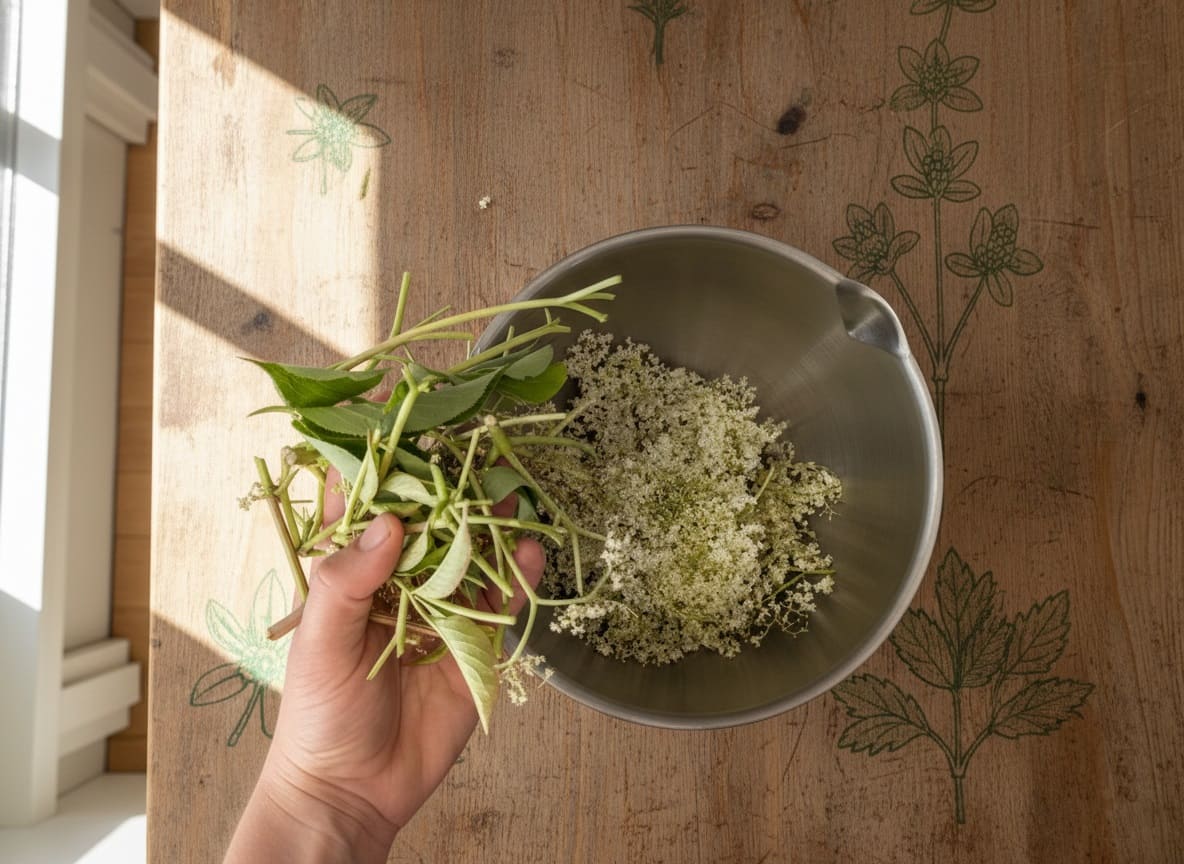
You’re aiming to remove the thick, woody stems completely, though the very fine stems holding individual flowers together are fine to leave.
This process takes about 20 minutes and is non-negotiable—those thick stems make your cordial bitter and contain compounds you don’t want to consume. Think of it as meditation with a purpose.
3. While you’re working on the flowers, wash your lemons thoroughly. If they’re waxed (most supermarket lemons are), give them a good scrub in hot, soapy water and rinse well.
Using a potato peeler or zester, remove the zest in strips, carefully avoiding the white pith underneath which adds bitterness.
Then slice the lemons into rounds about 1cm thick. Don’t worry about removing seeds—they’ll be strained out later.
4. In your large saucepan, combine the sugar and water. Place over medium-low heat and stir occasionally until every single grain of sugar has dissolved—this takes about 10 minutes and shouldn’t be rushed.
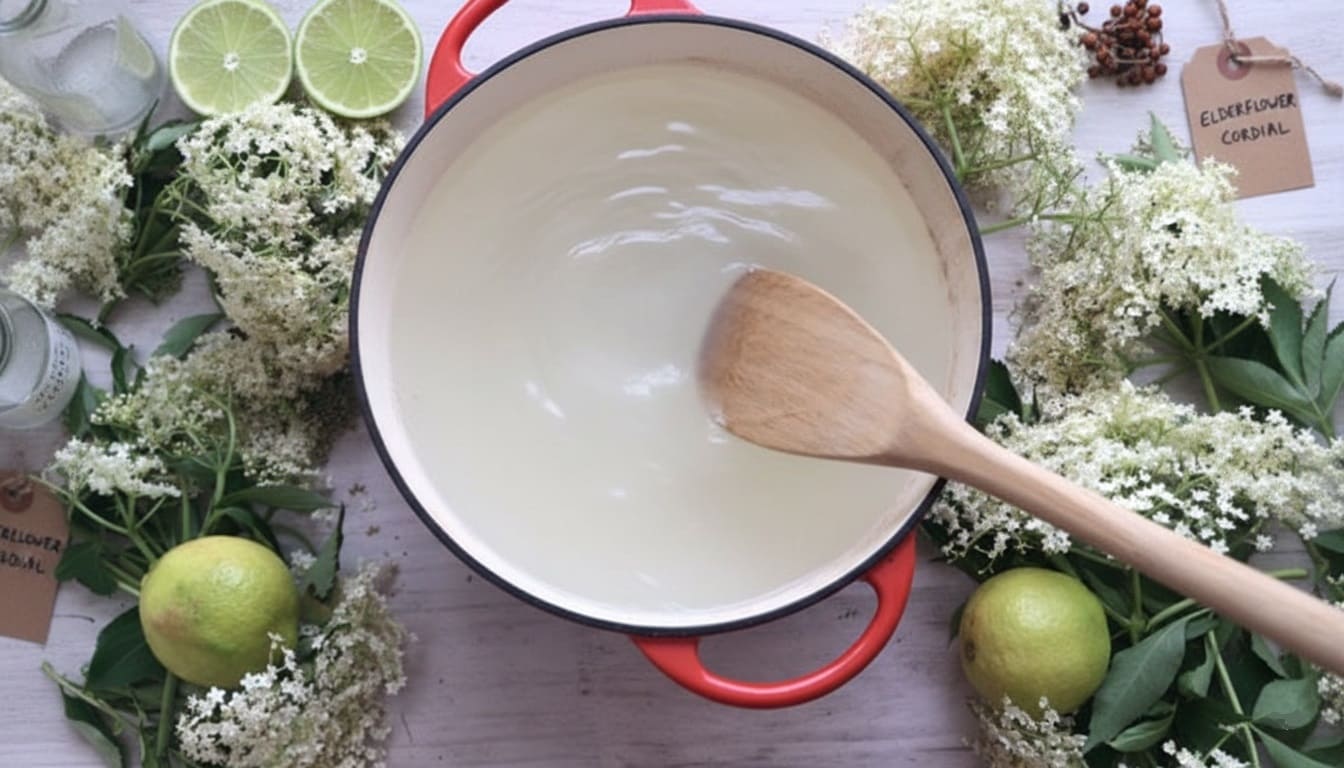
You can test by stirring and looking at the bottom of the pan; when no sugar crystals remain, it’s ready. Bring the syrup to a rolling boil, then remove from heat.
5. Here’s a step many recipes skip: let your syrup cool for 10-15 minutes. Pouring actively boiling liquid over delicate flowers can scorch them and alter the flavor.
The syrup should still be hot—around the temperature of a very warm bath—but not bubbling vigorously.
6. Place your prepared elderflowers and lemon slices in your large heatproof bowl. Pour the hot syrup over them and add the citric acid if you’re using it (more on this decision below). Stir gently to ensure all the flowers are submerged.
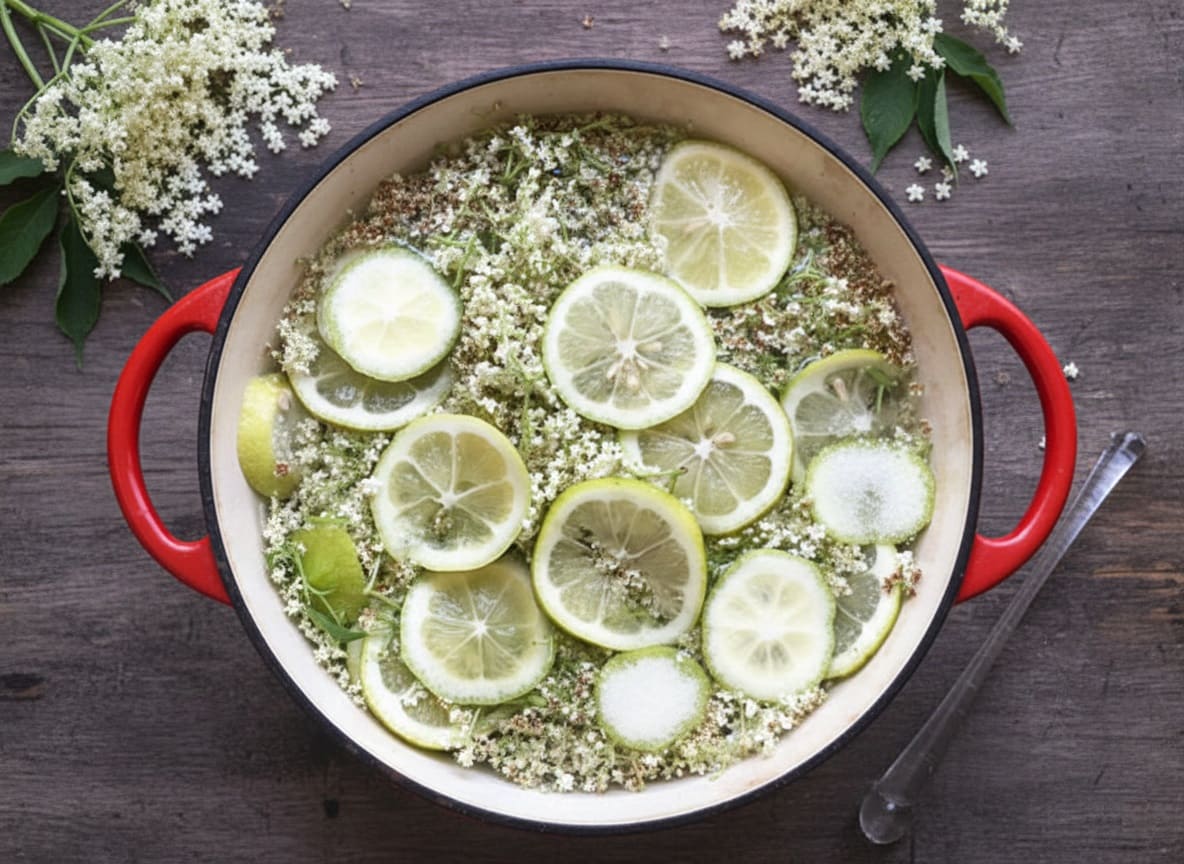
Cover with a clean tea towel or muslin—this keeps debris out while allowing the mixture to breathe. Place in a cool spot away from direct sunlight and leave to steep.
Day 1 Evening and Day 2: The Waiting Game
7. Give your mixture a gentle stir every 12 hours or so. The liquid will gradually take on color and fragrance as the flowers infuse their magic into the syrup.
Most recipes call for 24 hours steeping time, but you can extend this to 48 hours for a stronger flavor. I typically steep for about 36 hours, tasting after 24 to gauge strength.
Day 2-3: Strain, Bottle, and Store
8. Before you begin straining, sterilize your bottles. This isn’t just fussy perfectionism—it’s food safety.
Any bacteria or wild yeast in your bottles will feast on that sugar-rich cordial and cause spoilage.
Run glass bottles through your dishwasher’s hottest cycle, or wash thoroughly and then dry in a 140°C (275°F) oven for 20 minutes.
For lids, boil them for 5 minutes in water. If reusing bottles, check they’re crack-free and smell neutral.
9. Now for straining—this is where patience pays off. Line your sieve with a double layer of muslin (or a very clean tea towel) and place it over a large bowl or clean saucepan.
Ladle the cordial through, allowing it to drip naturally. This takes time, but letting gravity do the work produces crystal-clear cordial.
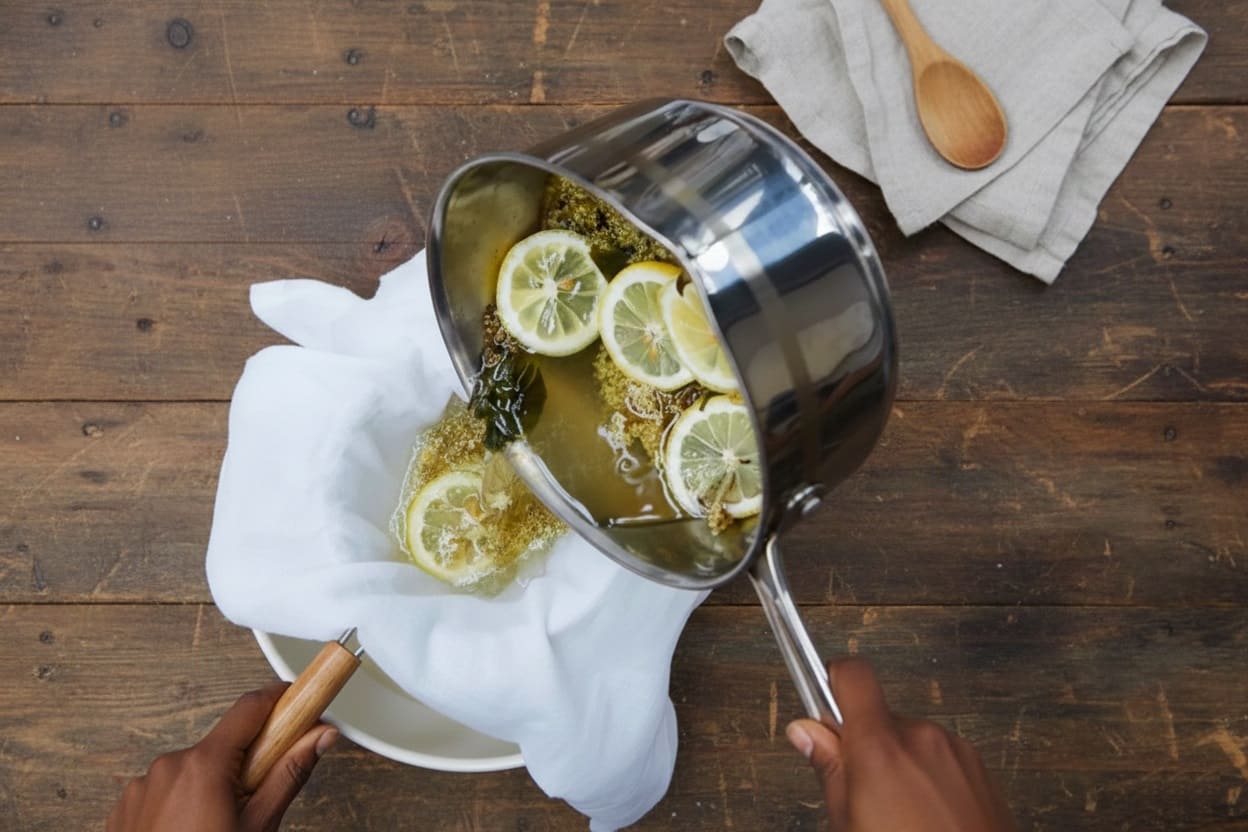
Once most of the liquid has drained, gather the corners of your muslin and gently squeeze to extract remaining liquid.
Don’t wring it like a dishcloth—excessive squeezing releases fine particles that cloud your cordial.
10. At this point you have a choice. For maximum shelf life, pour the strained cordial into a clean pan and bring to a gentle simmer for 5 minutes. This kills any wild yeasts and extends storage time.
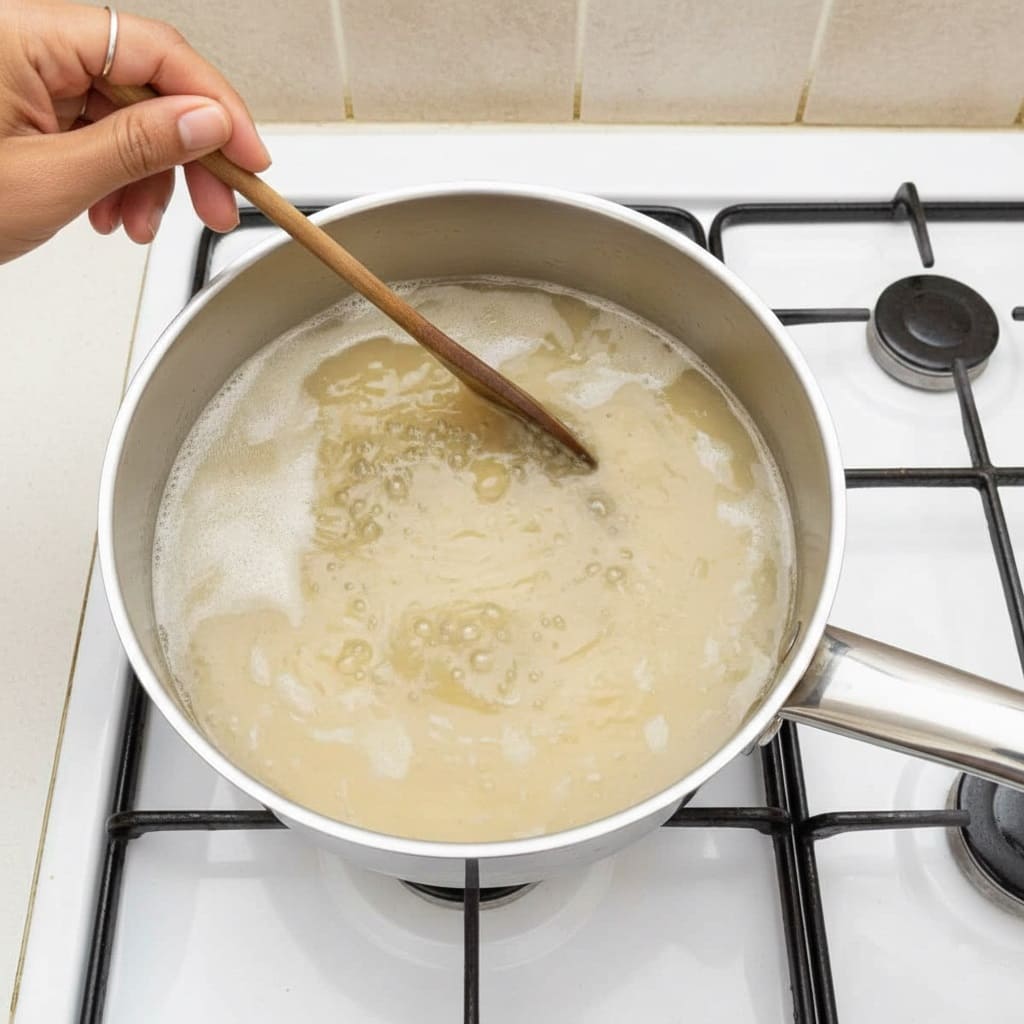
For a fresher, brighter flavor, skip this step and plan to use your cordial more quickly or freeze it.
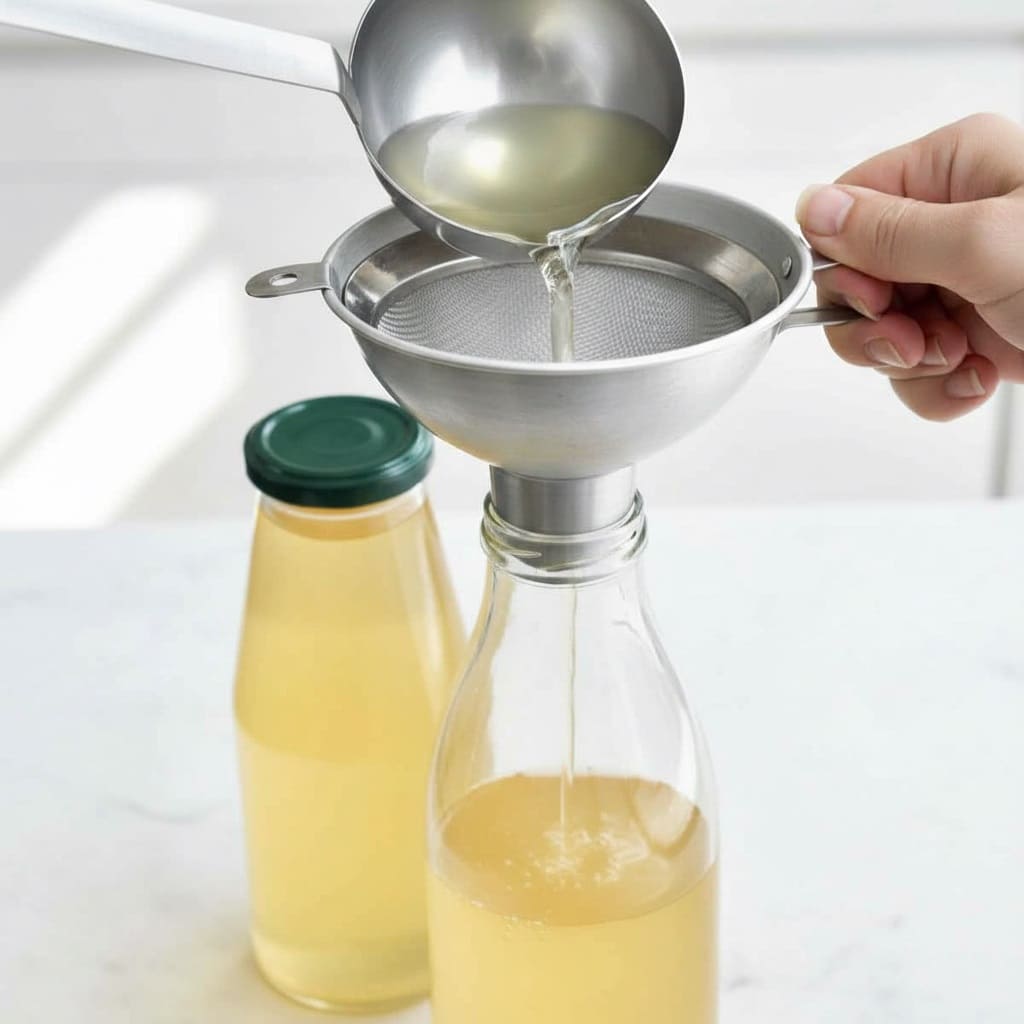
11. Using a funnel, pour the cordial into your warm sterilized bottles, leaving about 1cm of headspace at the top.
Seal immediately while still hot—as the cordial cools, it creates a vacuum seal that helps preservation.
👉 Learn about Freeze Concentration: A Game-Changer for Maple Syrup Makers
The Citric Acid Decision: What You Need to Know
Many elderflower cordial recipes call for citric acid, while others omit it entirely. Understanding what it does helps you decide which approach suits you best.
Citric acid serves two functions:
- Preservation and flavor. As a preservative, it lowers the pH of your cordial, creating an environment where bacteria and mold struggle to survive. This extends shelf life from a few weeks to several months.
- As a flavoring agent, it adds tartness that cuts through the sweetness and enhances the lemon notes.
If you use citric acid (25-50g per batch), your cordial will keep for 3-6 months in a cool, dark cupboard when unopened, and it’ll have a pleasantly sharp edge that balances the sugar.
You can find food-grade citric acid at pharmacies, homebrew shops, or online. When buying, confirm it’s food-grade, not the industrial cleaning version.
If you skip citric acid, your cordial will have a smoother, more purely floral flavor, but you’ll need to use it within 2-3 weeks even when refrigerated.
Some people substitute 2 tablespoons of apple cider vinegar or use an additional lemon, which provides some acidity without the sharp citric acid note.
- My recommendation:
Use citric acid if you’re making a large batch, giving bottles as gifts, or want the convenience of longer storage. Skip it if you prefer gentler flavor and plan to freeze portions for long-term keeping.
Variations Worth Trying
Once you’ve mastered the basic recipe, experiment with these creative variations:
- Honey-Sweetened Version
Replace half the sugar with a mild honey (clover or acacia work beautifully). The honey adds caramel notes and depth, though it darkens the cordial’s color.
- Pink Elderflower Cordial
Use flowers from black elder (Sambucus nigra ‘Black Lace’ or similar purple-leaved varieties). The blooms are tinged pink and create a gorgeous rosy-hued cordial.
- Herb-Infused Cordial
Add a few sprigs of fresh mint, lemon verbena, or basil during steeping for an herbal twist. Remove before the final simmer.
- Reduced Sugar Version
Cut sugar to 600-750g for a less sweet cordial. It won’t keep as long (2-3 weeks in fridge), so freeze in portions.
- Citrus Medley
Use a combination of lemons, oranges, and limes for a more complex citrus profile—try 2 lemons, 1 orange, and 1 lime.
👉 Read The Ultimate Guide to Growing Finger Limes: Tips for Cultivation
Storage Solutions for Every Situation
How you store your cordial depends on how quickly you’ll use it and how much you’ve made.
- Immediate use (1-2 weeks):
Keep an opened bottle in the refrigerator and use within a week of opening. An unopened bottle will last 2-3 weeks in the fridge if made without citric acid, or up to a month with citric acid.
- Medium-term (3-6 months):
Cordial made with citric acid and properly bottled hot can be stored in a cool, dark cupboard. Once you open a bottle, transfer it to the fridge.
- Long-term (up to 1 year):
Freezing is remarkably effective. Pour cordial into plastic bottles (not glass—it can crack), leaving 5cm of headspace for expansion.
Alternatively, freeze in ice cube trays, then pop the frozen cubes into freezer bags. Each cube equals one serving and can be dropped directly into drinks.
For true long-term shelf stability, you can water bath process your bottles. Fill hot bottles with hot cordial leaving 2.5cm headspace, cap loosely (don’t fully tighten), and place in a large pot lined with a folded tea towel.
Fill the pot with water to reach 2.5cm below the bottle tops. Bring to a simmer (not a rolling boil) and process for 20 minutes. Remove, tighten lids, and cool. Properly processed cordial keeps for a year in a cool, dark place.
When you eventually open a stored bottle, you might notice a yellow layer at the top—that’s just pollen that’s settled. Give the bottle a good shake before using.
If you see mold, cloudiness that won’t settle, or it smells fermented or off, discard it and make a fresh batch.
Troubleshooting Common Problems
My cordial turned cloudy
This usually happens from over-squeezing the muslin during straining or from using flowers that weren’t fresh.
Cloudy cordial is safe to drink but less attractive. You can strain it again through fresh muslin or coffee filters, though this is tedious.
It tastes bitter
Too many thick green stems weren’t removed, or flowers were past their prime and starting to turn.
The fix: strain through fresh muslin to remove any remaining particles, and sweeten with a bit more simple syrup (equal parts sugar and water, dissolved and cooled) to balance the bitterness.
👉 Here’s How to Get Rid of Bitter Taste in Cucumbers With 4 Simple Techniques
It’s too sweet
Personal taste varies widely. Simply dilute more when serving—instead of the standard 1 part cordial to 5 parts water, try 1:8 or even 1:10. You want to taste the elderflower, not just sugar.
It started fermenting (bubbles forming)
Natural fermentation has begun, meaning wild yeasts are converting sugar to alcohol. If it smells pleasantly wine-like, it’s safe but mildly alcoholic.
If it smells unpleasant, discard it. Prevent fermentation by using citric acid, sterilizing bottles properly, and storing in the refrigerator.
White film or mold on top
If made without citric acid, cordial can develop surface mold. While some experienced preservers simply lift off the mold and use the rest, I recommend discarding the batch for safety and making a new one with citric acid.
How to Use Your Elderflower Cordial
The most obvious use is as a refreshing drink: mix 1 part cordial with 5-8 parts sparkling or still water, add ice and a slice of lemon, and enjoy. But this versatile syrup shines in countless other applications.
In cocktails, elderflower adds sophisticated floral notes. Try the classic Elderflower French 75 (gin, cordial, champagne, and lemon), or simply add a splash to your gin and tonic.
Mix with prosecco, fresh mint, and soda for a Hugo Spritz, or shake with vodka and lime for an Elderflower Martini.
In the kitchen, elderflower’s delicate flavor complements fruit beautifully. Drizzle it over strawberries or gooseberries, fold it into whipped cream for Eton mess, or use it to soak the layers of a Victoria sponge cake.
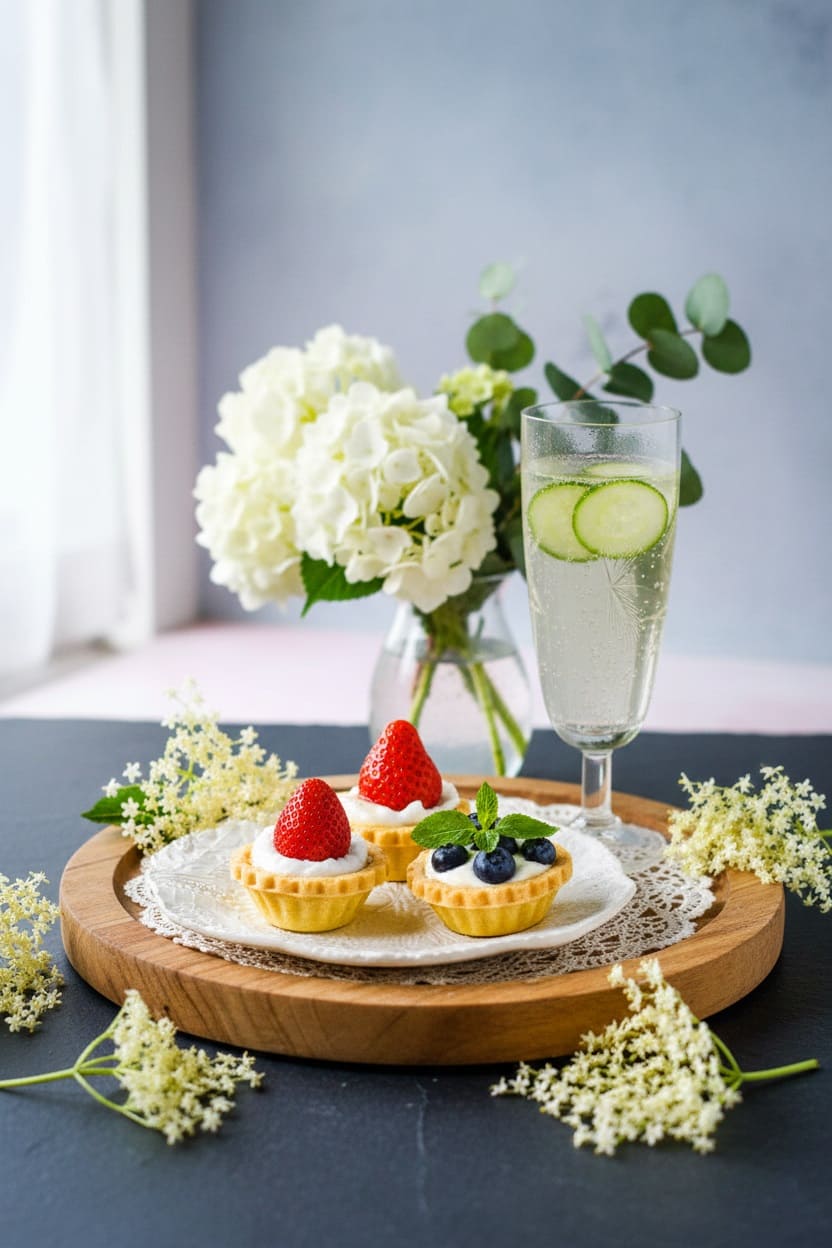
You can poach rhubarb or peaches in diluted cordial, reduce it to a syrup for drizzling over ice cream, or mix it into buttercream frosting. The floral notes pair particularly well with lemon-flavored desserts.
For something unexpected, try reducing cordial to a thick glaze for roasted chicken or using it to brighten salad dressings. The possibilities extend far beyond the drinks cupboard.
Quick Answers to Common Questions
- Can I use dried elderflowers?
Yes, especially useful for making cordial outside the bloom season. Use about half the amount by weight—roughly 10-15g dried flowers per liter of water. Dried flowers are available online, at Latin markets, or homebrew shops.
- I don’t have citric acid. Can I substitute something?
Try 2 tablespoons of apple cider vinegar or add an extra lemon. The flavor will differ slightly, but it adds necessary acidity.
- Can I make this with less sugar?
Yes, though sugar serves as both sweetener and preservative. Reduce to 600-750g if you prefer, but plan to use within 2-3 weeks and store in the fridge, or freeze in portions.
- How do I know if my flowers are too old?
If more than half the tiny flowers in each head have started turning brown, or if they smell unpleasant rather than fragrant, they’re past their best.
Some browning is inevitable when picking later in the season, but aim for mostly white, fresh-looking blooms.
- Is this safe during pregnancy or for children?
Yes, elderflower cordial is safe for everyone when properly prepared. The flowers are non-toxic, and the cordial is non-alcoholic unless it accidentally ferments.
Why This Recipe Matters
There’s something deeply satisfying about making elderflower cordial that goes beyond the practical.
The foraging aspect connects you to the landscape and seasons in a way modern life rarely demands.
The transformation of roadside flowers into something precious feels like small-scale magic.
And the result—a versatile ingredient that elevates everything from simple water to celebratory champagne—rewards you many times over for a couple of hours of effort.
From a practical standpoint, you’re creating 2+ liters of premium cordial (worth £15-20 in shops) for less than £2 in ingredients. You’re avoiding the artificial flavors and colors in commercial versions.
And you’re creating something uniquely yours—each batch varies slightly depending on the flowers you picked, the weather they grew in, and the choices you made.
But perhaps most importantly, you’re participating in a tradition that stretches back centuries.
People have been making elderflower cordial since Roman times, and the Victorian era established it as a quintessentially English summer drink.
When you make a batch and share it with friends, you’re passing on a skill, telling a story, and creating memories.
The elderflowers are waiting. This year, don’t let them pass by unnoticed. Take a basket, find your nearest hedgerow or woodland edge, and gather a few flower heads.
In just a couple of days, you’ll be sipping something magical that you made yourself, from flowers that cost nothing but a pleasant walk to collect.
Here’s to summer in a glass—made with your own hands.
Have you made elderflower cordial before? I’d love to hear about your experiences, favorite variations, or any questions you have. Drop a comment below, and let’s keep this conversation going!


Thank you so much for this post. I have been making elderflower cordial for years but I have never found such complete information and suggestions for what alternatives I could use and the reasons for each step.
I appreciate the low sugar guidelines in particular. I tried one too low in sugar once and it went off too quickly.
I usually make 3 batches each season and play with the mixes. I freeze them so it is available all year.
My favorite mix has lemons, oranges, and a bit of grapefruit. The grapefruit is just a lovely twist.
I will be making another batch tomorrow and I am going to try some mint.
thanks!