Picture this: You’re at the farm supply store, staring at a stack of golden bales. The sign says “straw,” but they look identical to the “hay” bales you saw at your neighbor’s barn. Does it really matter which one you buy?
If you’ve ever confused these two materials, you’re in good company. But here’s the truth: using straw when you need hay—or vice versa—can mean the difference between thriving livestock and hungry animals, or a weed-free garden and an accidental grain field.
The Core Distinction: Food vs. Function
The fundamental difference between hay and straw starts in the field, long before either reaches your farm.
Hay is preserved nutrition
Farmers cut grasses like timothy, orchardgrass, and bermudagrass—or protein-rich legumes like alfalfa and clover—while plants are actively growing and green.
Timing matters enormously here. The best hay is cut just before flowering, when the plant has maximum leaf content and nutrients but before energy shifts into seed production.
Everything gets harvested: leaves, stems, and immature seed heads. After sun-drying, this becomes nutritionally dense feed that keeps livestock healthy through winter.
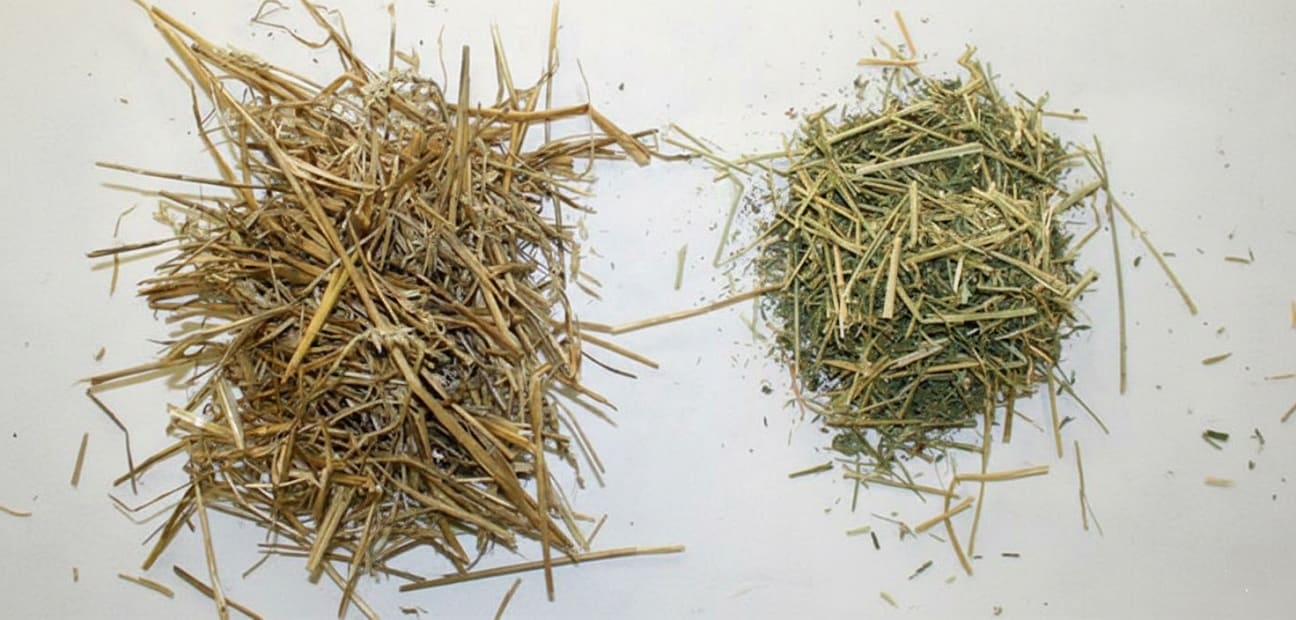
Quality hay retains a greenish color, feels soft and leafy, and smells sweet—like capturing a summer pasture in a bale. The greener the better, as brown or yellow hay has lost nutrients to sun bleaching or over-maturity.

Straw is structural leftover
After combines harvest wheat, oats, barley, or rye for grain, they leave behind hollow, golden stalks—essentially the skeleton of the plant after all nutritional value went into those seeds. These dry stems get collected and baled as straw.
With virtually no nutritional content, straw serves utilitarian purposes: bedding, mulch, erosion control, even building material.
Straw gleams golden-yellow, feels stiff and coarse (mostly hollow stems with few leaves), and has barely any scent. Pick up bales of equal size, and you’ll notice straw weighs noticeably less due to those air-filled stalks.

Nutritional Reality: Why It Matters
For livestock owners, this nutritional gap is everything.
Quality legume hay like alfalfa delivers 15-22% protein, substantial calcium (1.2-1.8%), and digestible energy of 2.0-2.5 Mcal/kg. Even grass hays provide 8-14% protein with moderate energy.
This makes hay essential for horses, cattle, goats, sheep, and rabbits—especially when pastures go dormant or animals lack grazing access.
👉 Here’s How to Reduce Hay Loss: Best Storage & Feeding Practices for Farmers
Straw offers a paltry 3-4% protein with high indigestible fiber (25-45%). Feeding straw as a primary diet is like asking someone to survive on cardboard.
While some farmers add small amounts to cattle rations purely for roughage to aid digestion, straw cannot replace proper feed. Animals fed primarily straw will slowly starve despite full bellies.
Choosing the Right Hay: Quality Indicators
Not all hay is created equal. Learning to assess quality protects your animals and your investment.
What to look for in quality hay
- Bright green color indicating proper harvest timing and minimal sun damage
- High leaf-to-stem ratio with fine stems—leaves contain most nutrition
- Soft, pliable texture that bends rather than snaps
- Sweet, fresh smell resembling mown grass
- Free from dust and mold—dusty or moldy hay causes respiratory issues
- No foreign material—weeds, sticks, wire, or trash indicate poor field management

Understanding hay cuttings
Farmers typically harvest hay fields three or more times per season.
- First cutting has thicker stems and may contain flowers, offering highest fiber.
- Second cutting is softer, greener, with higher protein but lower fiber—usually the premium choice.
- Third and later cuttings become increasingly fine and leafy but yield less tonnage.
Bale types matter
Small square bales (40-75 lbs) are easiest to handle manually—ideal for small farms and horse owners. Large square bales (800-1,500 lbs) require equipment but store efficiently.
Round bales (1,000-1,500 lbs) work well for outdoor feeding but can waste more if not managed properly. Choose based on your handling equipment and storage capacity.

For precise nutritional management, consider hay testing through your local extension office or veterinarian.
Testing reveals exact protein, fiber, and mineral content, allowing you to balance rations scientifically—especially important for performance horses or dairy operations.
Matching Hay to Animal Needs
Different livestock have different requirements:
- Horses thrive on grass hay (timothy, orchardgrass, bermudagrass) for maintenance, with limited alfalfa since excess protein can cause kidney stress. Working horses need higher-energy options. The general rule: horses should consume 1.5-2.5% of their body weight daily in hay.
- Dairy cattle benefit from alfalfa’s high protein and calcium for milk production. Dry cows and beef cattle do well on mixed grass-legume hays or quality grass hay.
- Goats and sheep are less picky but need leafier, finer hay since they won’t eat coarse stems. Legume hay suits lactating does and ewes.
- Rabbits and guinea pigs require unlimited grass hay (especially timothy) for digestive health and dental wear, comprising 80-90% of their diet.
👉 Discover 37+ Essential Cattle Breeds Every New Farmer Should Know
Straw’s Strengths: Where It Excels
Those hollow stalks that make straw nutritionally empty create perfect insulation and structure for other purposes.
Animal bedding
Straw’s air-trapping structure provides warmth while staying reasonably absorbent. It’s the bedding of choice for horse stalls, calving pens, chicken coops, and rabbit hutches. Use 6-8 inches for adequate cushioning and insulation.
Wheat straw absorbs moisture better than oat straw, though oat straw is softer. Barley straw splits the difference—softer than wheat but more absorbent than oat.

Garden mulch
Straw’s low seed content makes it ideal for vegetable beds. A 6-8 inch layer suppresses weeds, moderates soil temperature, retains moisture, and prevents soil-borne diseases from splashing onto plants.
As it slowly decomposes, it adds organic matter—though far less nutritional value than hay would provide.
Apply straw mulch after plants have established and soil has warmed. In cold-winter climates, use straw to protect perennials and overwinter crops, removing it in spring once frost danger passes.

The deep litter method
For winter chicken coops or livestock barns, layer straw continuously throughout the season without removing it. As lower layers decompose, they generate heat—providing natural warming while creating rich compost for spring gardens.
This method requires good ventilation to prevent ammonia buildup and works best in cold, dry climates.
Other applications
Straw protects newly seeded lawns from erosion and bird predation, creates pathways between garden beds, serves as erosion control on slopes, and—when compressed into bales—provides eco-friendly building insulation.
The Seed Situation: A Critical Distinction for Gardeners
This difference can make or break your gardening season.
Properly processed straw should be essentially seed-free since combines removed grain heads during harvest.
You might find occasional stray wheat or oat kernels, but these germinate easily visible and pull out simply. Even if a few sprout, they’re annual grains without persistent root systems.
Hay, conversely, often gets cut before seeds fully mature, but they’re still present—along with seeds from whatever else grew in that field. Spread hay mulch around tomatoes, and you may inadvertently plant timothy grass, clover, or a full weed festival.
Many enthusiastic gardeners who tried hay mulch report spending the entire following season pulling grass sprouts.
If you must use hay for garden mulch, employ these strategies:
Let bales sit exposed to weather for several months so seeds sprout and die, lay newspaper or cardboard beneath hay mulch to smother emerging seedlings, or use only very mature hay where seed viability has diminished.

Storage: Protecting Your Investment
Both materials require dry, covered storage, but hay demands more vigilance.
Essential storage principles
- Stack on pallets, gravel, or old tires—never directly on soil
- Provide overhead protection from rain and snow (barn or heavy tarps)
- Ensure air circulation between bales (never pack tightly)
- Orient bales so twine runs vertically to shed water
- Position round bales end-to-end, not touching sides
- Keep first-in, first-out rotation
Why hay storage is critical
Hay baled above 20% moisture can develop dangerous mold that causes respiratory illness in animals. Worse, improperly cured hay generates heat through decomposition—internal temperatures can reach combustion point, causing devastating barn fires.
Never stack fresh hay deeply without checking for heating.
Properly stored hay maintains quality for 6-12 months, though nutritional value gradually declines. Straw, being already dead material, lasts 1-2 years or longer if kept dry.
Check stored hay regularly. If bales feel warm, smell musty, or show white dust (mold spores), discard them safely—never feed moldy hay to animals.

Cost Considerations
Budgeting requires understanding typical price ranges, though these vary by region, season, and quality.
Hay generally runs $117-$330+ per ton ($5-$15 per small square bale), with premium alfalfa commanding top prices. Prices spike in winter or drought years when supplies tighten.
Straw typically costs less—$4-$6 per small square bale, $50-$75 for large rounds—since it’s a byproduct crop. However, in regions without significant grain production, imported straw can exceed local hay prices.
Calculate your needs: A 1,000-lb horse consumes roughly 20 lbs of hay daily, meaning 3.5+ tons annually. At $200/ton, that’s $700+ in hay costs alone—a significant line item in your farm budget.
Warning: The Herbicide Hazard
Before purchasing either material, ask about herbicide use. This isn’t paranoia—it’s essential protection for your garden.
Some persistent herbicides (aminopyralid, clopyralid) used on hay fields or grain crops don’t break down quickly. These chemicals remain active in baled material, survive composting, and can persist in manure.
When you spread contaminated hay or straw as mulch, these herbicides leach into soil and kill broadleaf plants—including your vegetables.
Countless gardeners have suffered total crop failure from unknowingly using contaminated mulch. Tomatoes, beans, and peppers are especially susceptible, showing twisted growth and eventual death.
Always ask sellers: “Were any herbicides applied to these fields?” Buy from reputable sources who can verify either organic production or herbicide-free management.
If uncertain, test by planting sensitive crops (like beans) in small amounts of the material before using extensively.
👉 Here’s How to Grow Yard Long Beans: Planting, Growing & Harvesting Success Tips
Regional Variations and Alternatives
Not all straw comes from wheat. Rice-growing regions produce rice straw that works perfectly for bedding and mulch, though its higher silica content can be harder on equipment.
Oat hay (harvested green before grain matures) provides a middle ground between grass hay and straw.
In some regions, alternative bedding materials include pine needles (pine straw), which resist decomposition and acidify soil gradually—ideal for blueberries or acid-loving plants.
Wood shavings work well for animal bedding but add little nutrition when composted. Each has distinct characteristics worth exploring based on local availability and cost.
Quick Decision Guide
Choose hay for:
- Primary livestock feed (horses, cattle, goats, sheep, rabbits)
- Supplementing winter nutrition
- Boosting soil fertility through composting
- When nutritional content matters more than cost
Choose straw for:
- Animal bedding in barns, coops, and stalls
- Vegetable garden mulch (weed-free applications)
- Protecting newly seeded lawns
- Deep litter method for winter warmth
- Construction or insulation projects
- When seed content and cost matter most
Frequently Asked Questions
- Can I feed straw to my animals?
Straw lacks nutrition to serve as primary feed. Some farmers add minimal amounts to cattle diets for roughage, but animals need proper hay or grain for nutritional requirements. Young animals especially cannot thrive on straw.
- Why does hay sometimes cost less than straw in my area?
In grain-growing regions, straw is abundant and cheap. Where little grain is grown (parts of New England, for example), straw must be trucked in, making it pricier than locally-produced hay. Supply and demand rules apply.
- Can animals eat their straw bedding?
Horses and cattle may nibble straw bedding out of boredom, but it provides negligible nutrition. If animals consume large quantities, they’re likely not receiving adequate feed—increase their hay ration.
- Will hay work as bedding?
Technically yes, but it’s wasteful. Hay costs more, holds excess moisture (increasing mold risk), and animals eat their bedding rather than resting on it. Save expensive hay for feed; use cheap straw for bedding.
- How do I know if hay has gone bad?
Trust your senses: musty smell, visible mold (white dust or dark patches), excessive dust when moved, or warm internal temperature all indicate spoilage. Never feed questionable hay—respiratory issues and colic can result.
Making It Work on Your Farm
Understanding hay versus straw transforms from academic knowledge to practical farm management when you match materials to purposes.
That means feeding premium alfalfa to your dairy goats while bedding them on wheat straw—getting optimal nutrition and comfort while managing costs effectively.
Whether you’re establishing a first garden, expanding livestock operations, or improving existing practices, choosing correctly between hay and straw affects animal health, garden productivity, and your bottom line.
The next time you encounter those golden bales, you’ll know exactly what you need—and why it matters.
What’s been your experience with hay or straw? Have you discovered clever uses or learned lessons the hard way? Share your practical wisdom in the comments—your insights might save another farmer or gardener considerable trouble!

