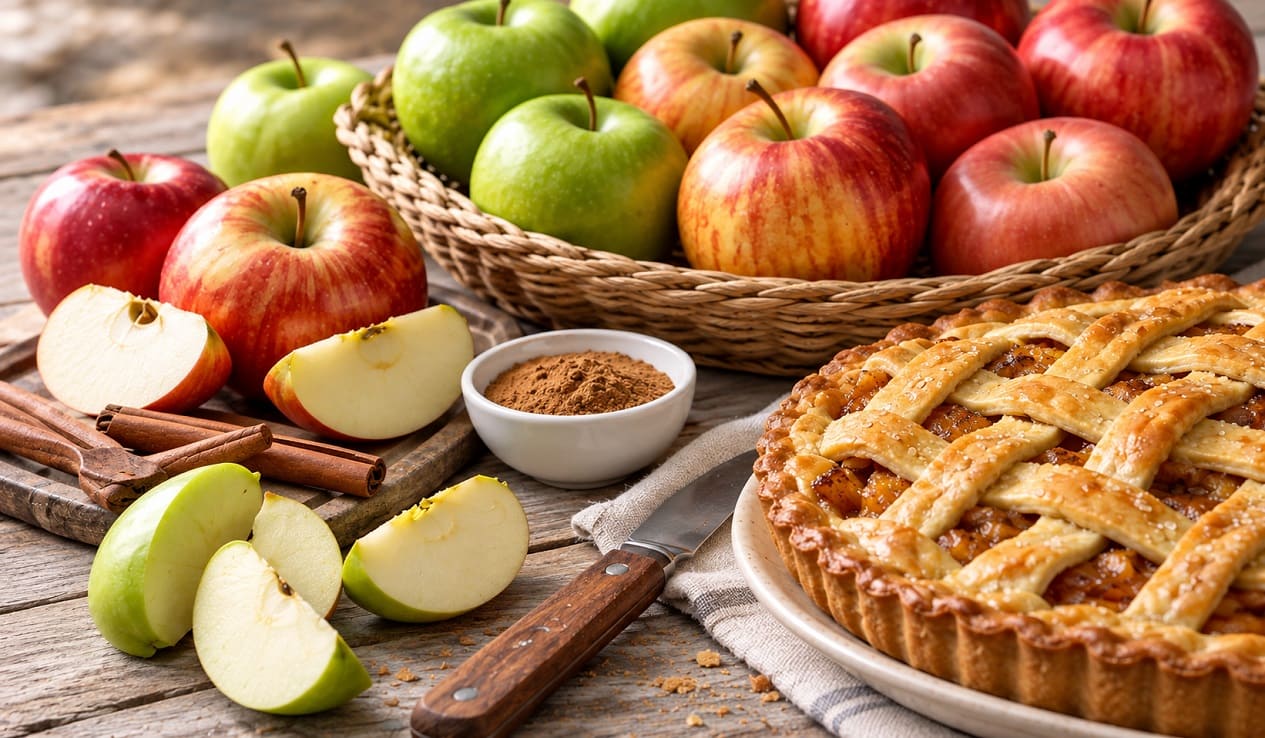
The best apples for apple pie stay firm, lean a little tart and still taste like apple after an hour in the oven.
At an ordinary grocery store, that means Braeburn, Granny Smith, Honeycrisp, Pink Lady, Jonagold or a fresh Golden Delicious, and a pie made with two of them usually beats a pie made with one. Red Delicious and Gala are the ones to leave on the shelf.
Choose well and you get a pie that slices cleanly and tastes of fruit rather than just sugar and cinnamon, even if all you have is a supermarket.
Quick picks
- Best single apple: Braeburn, or Granny Smith if you like a tart pie.
- Easiest pairing: half Granny Smith, half Honeycrisp or Golden Delicious.
- For deeper apple flavor: swap one or two McIntosh or Cortland in for some of the firm apples.
- Skip: Red Delicious and Gala. Use McIntosh only as a small share of a mix.
- How many: 2½ to 3 pounds (1.1 to 1.4 kg), or roughly 7 to 9 medium apples, for a standard 9-inch (23 cm) pie; about 4 pounds (1.8 kg) for deep-dish.
What Makes a Good Pie Apple
A pie apple has a harder job than a snacking apple. It has to bake for an hour or more, soften all the way through and still come out as a slice rather than a puddle. Four traits decide whether it manages:
- Apple flesh is held together by pectin, the same gelling substance that sets jam. Dense apples with little air between their cells, like Braeburn, keep their shape even when fully tender. Airy, loose-fleshed apples such as McIntosh slump into sauce.
- Tartness balances the sugar in the filling, and acid also slows the breakdown of pectin as the apple cooks, so tart apples tend to stay firmer. That’s why sweet, low-acid apples so often bake up both sugary and soft.
- Flavor that survives heat. Some apples taste great raw and go flat once cooked. Others, Golden Delicious in particular, taste better baked than fresh.
- Moderate juice. Every apple weeps as it bakes. Very juicy varieties flood the filling and soak the bottom crust unless you thicken or drain them.
Raw crunch isn’t a reliable guide. Some modern snacking apples are bred for a crisp, fracturing bite that turns grainy in the oven, and Gala is the best-known example.
You may also read that apples which brown slowly after cutting are the tart, firm ones. Acid does slow browning, but so does a naturally low level of the browning enzyme, which is why a mild apple like Opal stays white for hours. Go by variety and firmness instead.
👉 Discover 35+ Apple Varieties With Selection Tips & Their Perfect Uses
The Best Grocery-Store Apples for Pie
These are the varieties you can find in most US supermarkets for at least part of the year, judged on how they bake rather than how they eat raw.
| Apple | Baked texture | Flavor in pie | Best use |
| Braeburn | Firm but tender; releases little juice | Sweet-tart and spicy, almost pear-like | Stands alone or anchors a mix |
| Granny Smith | Firm; reliably keeps its shape | Bright and tart, not very apple-y | The tart half of a pair |
| Golden Delicious | Soft but sliced, if fresh | Rich and buttery; deepens as it bakes | Flavor apple; alone for a softer pie |
| Honeycrisp | Firm with some bite | Sweet with mild tartness | The sweet half of a pair |
| Pink Lady (Cripps Pink) | Very firm, fairly dry | Sweet-tart and bright | Mixes; neat slices |
| Jonagold | Softens but holds | Honeyed, gently tart | Mixes, especially in early fall |
| Cosmic Crisp | Firm and juicy | Sweet with a little tartness | The sweet half of a pair |
| Jazz | Dense and firm; holds its slices | Tangy-sweet | The sweet half of a pair |
Braeburn is the closest thing to a do-everything pie apple. It softens fully, keeps its shape and gives off little liquid, so the filling stays saucy rather than soupy.

It’s harvested late and stores well, which makes it a dependable choice for holiday baking.
Granny Smith earned its reputation honestly. It’s sold year-round, its acidity stands up to plenty of sugar and spice, and in most kitchens it holds its shape.

Its weakness is flavor: on its own it tastes more tart than apple-y, and long-stored supermarket Grannies sometimes bake up softer and grainier than their reputation suggests.
Use it as the tart half of a pair rather than the whole pie, unless you love a sharp filling.
Golden Delicious splits opinion more than any other apple, and freshness is usually the reason.

A firm, recently harvested Golden bakes into the richest-tasting filling of any common apple, soft but still in slices. One that has spent months in storage turns mealy and collapses.
Buy it in the fall, press it before it goes in your bag, and pair it with something firmer if you’re unsure.
Honeycrisp and Cosmic Crisp hold up well and bring sweetness, but they cost more than most apples and lean sweet, so they shine next to a tart one.

Pink Lady is about as firm as pie apples get. On its own it can bake up slightly dry and chewy, so slice it on the thin side or mix it with a juicier apple.

Three more supermarket apples bake well, though all of them lean sweet and need a tart partner or a little lemon juice:
- Pacific Rose: firm and sweet with only mild acidity, and it keeps its shape in the oven.
- Opal: dense and pear-like, with flesh that stays intact under a crust. It’s too sweet to make up more than about half the filling.
- Ambrosia: honey-sweet with almost no acid, but its texture survives baking.
Apples to Use Sparingly or Skip
Good in Small Amounts
McIntosh has the most classic apple-pie flavor of all, tart and cider-like, but it melts into sauce in the oven.

In a pie of firmer apples, a quarter McIntosh fills the gaps with smooth, flavorful sauce. Use more and the filling shrinks away from the top crust.
Cortland behaves much the same but holds together slightly better, and Macoun, a McIntosh relative sold for a few weeks each fall in the Northeast, can fill the same role.

Fuji is sweet, juicy and mild. Bakers disagree about its texture, which ranges from pleasantly medium-firm to watery from one batch to the next, so treat it as a sweet partner for Granny Smith and add a little extra thickener.

Jonathan, an older tart variety common in the Midwest, softens a lot but tastes excellent in a mix.

Better Left on the Shelf
Red Delicious is bland and mealy raw and no better baked, and its thick skin can taste bitter

Gala is pleasant fresh, but in side-by-side baking tests it repeatedly turns grainy and loses its flavor, which is hard to forgive in a pie. Neither will ruin a filling as a small share of a mix, but there’s no reason to buy them for one.

A few others get conflicting reviews. Envy, Mutsu (also sold as Crispin), Rome and Empire are praised by some bakers and called grainy, bland or mushy by others.
If you have them, run the quick test described below before committing a whole pie.
One Variety or a Mix?
You’ll often see a mix recommended as the secret to great pie, but a single variety has a real advantage: every slice cooks at the same rate, so the texture is even and predictable from pie to pie.
Pairing a firm apple with a soft one gives you some slices that hold and some that collapse. Whether that’s a flaw or the whole point depends on what you like.
- You want neat, even slices: use one firm, balanced apple such as Braeburn, or two firm apples with similar texture, like Granny Smith and Pink Lady.
- You want more flavor than one apple gives: pair a tart apple with a sweet one of similar firmness. Granny Smith with Honeycrisp, Jonagold or Golden Delicious is the easiest grocery-store pair.
- You like a saucy, old-fashioned filling: add a soft, flavorful apple like McIntosh or Cortland as up to a quarter of the total, so it melts around the firmer slices.
For a three-apple pie, a good starting ratio is two parts firm-tart, two parts firm-sweet and one part soft. Taste the result and adjust the next pie from there.

When you combine textures, cut the softer apples a little thicker than the firm ones so they finish at the same time.
Regional and Heirloom Apples Worth Seeking Out
If you live near orchards, some of the best pie apples may never reach a supermarket. Look for these in season:
- Northern Spy: firm, tart and one of the few heirlooms that can carry a pie alone. It’s grown mostly in the Northeast and around the Great Lakes and is picked in late fall.
- Winesap and Stayman: tangy, wine-like late apples that hold their shape and keep well.
- Newtown Pippin (also sold as Albemarle Pippin): a tart, firm colonial-era apple that holds its shape and gains flavor after a few weeks in storage.
- Baldwin: an old New England keeper with firm flesh and a mild sweet-tart flavor.
- Arkansas Black: a very hard, dark red late apple from the South. It’s at its best after several weeks of storage and bakes up firm with deep flavor.
- GoldRush: a modern, late-ripening apple that’s tart, very firm and keeps for months, which makes it a good choice for winter pies.
- Esopus Spitzenburg, Rhode Island Greening and Calville Blanc: old varieties prized for intense flavor and slices that stay intact.
- Golden Russet and Roxbury Russet: dense, sweet-tart and fairly dry, so they stay firm and won’t flood the crust.
- Haralson: a tart, firm Minnesota apple sold across the Upper Midwest.
- Gravenstein: fragrant and tart but soft. It ripens in late summer, is best known from Sonoma County, California, and should go into pie before it’s fully ripe.
- Early-season options: if you bake in August or early September, Golden Supreme and Ginger Gold soften more than late apples but mostly hold their shape, and the short-season Pink Pearl adds tartness and pink flesh. Pair any of them with a firmer apple such as Granny Smith.
Be wary of signs that say “old-fashioned pie apple.” Pie tastes have changed, and some heirlooms earned that label by cooking down completely. Wolf River is a well-known example that turns to applesauce inside a crust.
Ask the grower one question: does it hold its shape when baked? Most will happily tell you, and many will let you taste one.
Outside the US, the same rules apply to whatever your market sells.
- In the UK and Ireland, Bramley is the standard cooking apple; it’s very tart and cooks to a soft, fluffy pulp, so mix it with a firm eating apple such as Braeburn or Cox if you want visible slices.
- In the Netherlands, Belgium and Germany, Belle de Boskoop fills a similar role and is firmer.
- In Australia and New Zealand, Granny Smith, Braeburn and Pink Lady are all grown locally, and the new crop arrives from late summer into autumn, roughly February to May.
Freshness Matters as Much as Variety
The same variety can bake beautifully in October and fall apart in June. Supermarket apples are held in cold, low-oxygen storage for many months, sometimes close to a year.
They look fine on the shelf, but their flesh softens quickly once they leave storage, and that weakened structure shows up in the oven as mush or mealiness.
In the Northern Hemisphere, apples are harvested from late summer through November, and that’s when pie apples are at their firmest.
Summer apples are generally softer than late-harvest keepers like Braeburn, Northern Spy and Granny Smith.
When you shop:
- Press the apple firmly with your thumb. A good pie apple doesn’t dent.
- Choose fruit that feels heavy for its size, with taut skin and no soft or bruised spots.
- If you’re picking your own, take apples that are just ripe rather than fully soft; they bake firmer.
At home, keep apples in the refrigerator in a loosely closed or perforated bag rather than in a fruit bowl, because they soften far faster at room temperature.
If you’re baking in spring or summer, buy apples from the refrigerated case if you can, keep them cold and lean on firm varieties like Granny Smith and Pink Lady.
Test Unfamiliar Apples Before You Bake
If you’ve come home with a bag of apples that has no name, or you want to know how your local varieties behave, a muffin-tin test gives you an answer in under an hour.

You’ll need: one apple of each variety, a muffin tin, sugar, salt and foil.
- Heat the oven to 375°F (190°C) and lightly grease one muffin cup per variety.
- Peel, core and slice each apple ¼ inch (6 mm) thick, keeping the varieties separate.
- Toss each pile with about 1 teaspoon of sugar and a tiny pinch of salt, then pack the slices into their own cup. Write down which variety went where.
- Cover the tin with foil and poke a few holes in it, so the apples steam the way they would under a top crust.
- Bake until a knife slides easily into the firmest cup, usually 25 to 40 minutes.
- Let everything cool completely, then taste. Cooled apples tell you far more than hot ones.
You’re looking for slices that are tender all the way through but still distinct, a smooth rather than grainy texture, and a clear apple flavor. A variety that collapses but tastes wonderful is still useful as the soft part of a mix.
Adjusting Your Filling to the Apples You Bought
Most recipes are written with one kind of apple in mind, usually Granny Smith. If you use something else, a few small changes keep the filling balanced.
- Sweetness:
Taste a slice before adding sugar. With sweet apples like Honeycrisp, Fuji or Golden Delicious, cut the sugar by about a quarter and add 1 tablespoon of lemon juice. For an all-Granny Smith filling, use the full amount.
- Juice
Juicy apples need more thickener. Alternatively, let the slices sit with the sugar for 30 to 60 minutes, drain off the liquid, boil it down to a syrup and stir it back in. Braeburn and Pink Lady give off so little that you can often use less thickener.
- Slice thickness
About ¼ inch (6 mm) suits most apples. Go up to ½ inch (13 mm) for soft varieties so they don’t dissolve, and stay at ¼ inch for very firm ones so they cook through.
- Softer apples
A gentle warm-up before baking helps them keep their shape. Warming the slices to roughly 140 to 160°F (60 to 70°C), well below a simmer, for about 10 minutes switches on an enzyme in the apple that makes its pectin more heat-stable.
The simple way is to pour just-boiled water over the slices, cover for 10 minutes, then drain them well and let them cool before filling the pie.
- Doneness:
Bake until thick juices bubble through the vents and a knife meets no crunch.
The center of the filling should reach about 195 to 200°F (90 to 93°C); firm apples often need 60 to 75 minutes or more to get there. Then let the pie cool for at least 2 to 3 hours so the filling sets.
👉 Learn How to Dehydrate Apples at Home: Easy Steps for Perfect Results
If a pie still disappoints, the apples usually explain why:
| Problem | Likely cause | Fix next time |
| Mushy, applesauce-like filling | Soft variety, long-stored apples or thin slices | Firmer apples bought in season, thicker slices or a gentle warm-up |
| Grainy or mealy texture | Gala, Red Delicious or old stock | Change varieties; baking can’t fix it |
| Crunchy apples under a finished crust | Very firm apples or a short bake | Thinner slices, a foil shield on the edges and a longer bake |
| Soupy filling, soggy bottom | Juicy apples, too little thickener or cutting it warm | Drain and reduce the juices, add thickener, cool fully |
| Big gap under the top crust | Raw apples shrinking, especially soft ones | Pack and mound the slices, or warm them first |
| Sweet but flat flavor | Only low-acid apples | Add a tart apple or lemon juice |
Frequently Asked Questions
Do I need to peel apples for apple pie?
Not always, but most pies are better peeled. Thick skins like those of Red Delicious and Granny Smith stay tough and curl into chewy strips.
Thin-skinned apples such as Golden Delicious and Pink Lady can go in unpeeled for a rustic pie, and the skin adds a little color.
Are the best apples for apple crisp the same as for pie?
Mostly, but a crisp is more forgiving. With no bottom crust to soak, it can take juicier, softer apples like Fuji or McIntosh, and many people prefer a jammier filling under a crumble.
Firm pie apples work in a crisp too, especially tart ones under a sweet topping.
Can I use apples that have gone a little soft?
Only in small amounts. Mix one or two into a pie of firm apples, where they’ll melt into the sauce, or turn them into applesauce, apple butter or cake. A whole pie of soft apples will collapse and leave a gap under the crust.
Where to Start
If you’re standing in the produce aisle without a plan, buy two kinds of firm apples, one tart and one sweet. Granny Smith with Honeycrisp, Golden Delicious or Braeburn will make a very good pie almost anywhere in the US.
Press each apple before it goes in the bag, buy in season when you can and keep them cold until you bake. After that first pie, try swapping one apple for a local variety and see if you like it better.

